


If you have ever booked a venue in Singapore and been told it is a “dry hire” space, you may have assumed that meant you were starting from scratch with absolutely nothing. The reality is more nuanced, and that misunderstanding catches planners out regularly. What is dry hire event furniture, exactly, and what does it mean for your setup responsibilities? The answer depends on your supplier, your venue, and what you confirm in writing before the event date. This guide breaks down the dry hire furniture meaning, compares it to wet hire, and gives you a practical checklist for managing it well.
| Point | Details |
|---|---|
| Dry hire means furniture only | You rent the furniture itself; setup, operation, and breakdown are typically your responsibility to organise. |
| Inclusions vary by supplier | Some Singapore suppliers include delivery and setup; others do not. Always confirm in writing before signing. |
| Wet hire offers more support | Wet hire bundles furniture with staffing and operational support, which suits planners with limited internal capacity. |
| Costs can add up | Dry hire venue fees are lower, but external supplier costs for furniture, cleaning, and security can offset savings. |
| Coordination is non-negotiable | Written run-sheets covering delivery windows, placement, and crew responsibilities are critical even without staffing. |
At its most straightforward, dry hire refers to renting furniture or equipment on its own, without bundled staff, operational support, or turnkey services. You get the chairs, tables, lounges, or display units. What you do with them, how you move them, where you place them, and how you pack them away is on you or your team.
That said, the dry hire furniture meaning in Singapore is not always so clean-cut. Suppliers vary considerably in what they include under the same label. Some providers will deliver furniture to your venue, set it up according to your floor plan, and return at the end of the event to collect and remove everything. Others will drop items at the loading bay and expect your crew to handle the rest. Neither model is wrong. They are simply different service levels, and the distinction matters enormously when you are building your event day schedule.
The venue context adds another layer of complexity. Most dry hire venues provide basics such as standard furniture, WiFi, and access to shared facilities, but exclude catering and production. So a dry hire venue may come with some furniture already in place. Whether that furniture suits your event layout is a separate question entirely.
Here is what you should clarify before confirming any dry hire furniture arrangement:
Getting answers to these questions in writing protects you and removes ambiguity on the day.
The dry hire vs wet hire distinction is one of the most useful frameworks for event planners when assessing supplier proposals. Understanding it clearly helps you budget accurately and allocate your team’s time.
| Factor | Dry hire | Wet hire |
|---|---|---|
| What you receive | Furniture or equipment only | Furniture plus staffing and operational support |
| Setup responsibility | Planner or planner’s crew | Supplier’s team |
| Cost | Lower base fee | Higher all-in fee |
| Flexibility | High. You control layout and timing | Lower. Supplier manages the process |
| Best suited to | Planners with internal capacity and clear run-sheets | Planners who need hands-off delivery |
| Risk | Higher if coordination is poor | Lower, but less creative control |
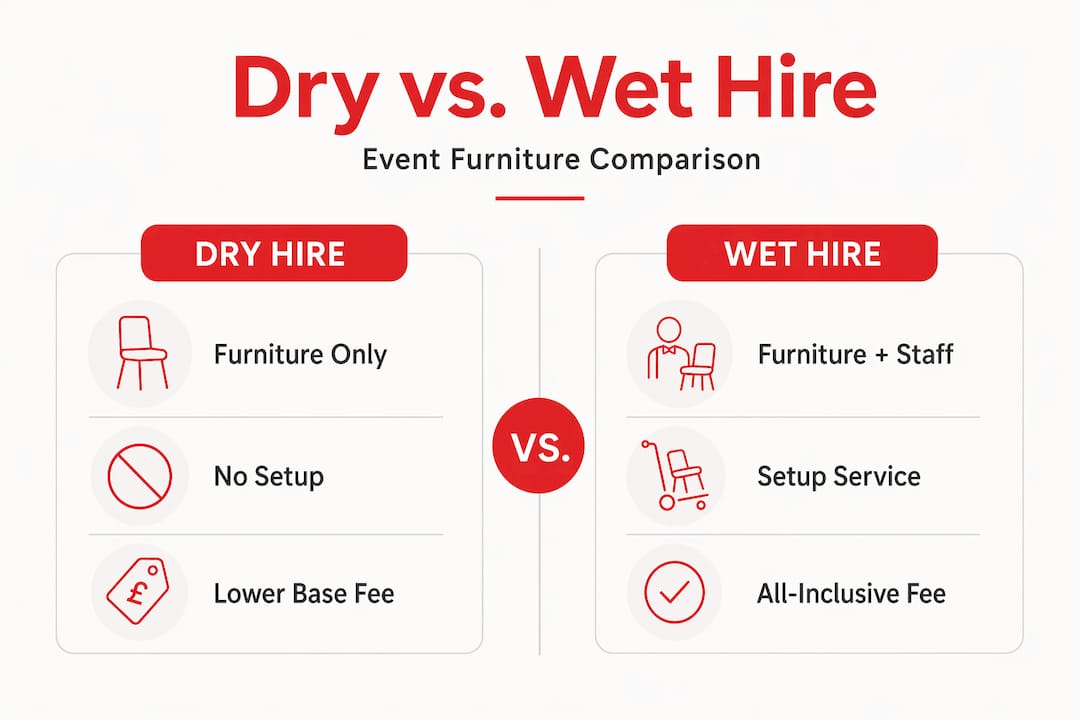
Dry hire suits events where you have an experienced in-house team or trusted freelancers who can manage furniture logistics. Dry hire is best if you have your own technical team or established freelancer relationships to handle setup, operation, and teardown. For a corporate planner managing a recurring conference series with a reliable crew, dry hire is often the smarter financial choice.
Wet hire makes sense when you are working with a smaller team, running a complex multi-zone event, or simply cannot afford the coordination risk. The higher fee buys you peace of mind and a supplier who owns the outcome.
One nuance worth noting: dry hire venue fees are roughly 45% cheaper but total event costs can be 13 to 19% higher than full-service venues once you add external catering, security, cleaning, and furniture hire. The headline saving can be misleading if you have not mapped out every additional cost.
Pro Tip: Before committing to dry hire, list every operational task involved in furniture setup and breakdown, then honestly assess whether your team has the time and capacity to manage each one. If more than three tasks are unassigned, wet hire or a supplier with setup services will likely save you money in the long run.
Dry hire is not simply a product category. It is a contracting model, and the coordination work that surrounds it is just as important as the furniture itself. Here is a practical sequence for managing it well.
Confirm the full inventory in writing. Before anything else, get a written list of every item being hired, including quantities, dimensions, and condition standards. Verbal agreements dissolve quickly under event-day pressure.
Map your floor plan against the default furniture. Venues’ default furniture configuration may be insufficient or mismatched for lounge seating or VIP layouts. Overlay your event flow diagram on the venue’s standard layout and identify every gap.
Clarify access windows. Delivery and setup windows are often tighter than planners expect, particularly at Singapore venues with shared loading bays or restricted lift access. Confirm the earliest possible access time and build buffer into your schedule.
Request setup and removal as an add-on if needed. Delivery, setup, and removal can be handled by supplier teams even under equipment-only dry hire terms. Ask your supplier directly whether this service is available and what it costs. Many Singapore providers offer it as an optional extra.
Build a written run-sheet for furniture logistics. Coordination includes confirming delivery access, delivery windows, who arranges placement, and physical layout of furniture. Your run-sheet should name the responsible person for each task, not just the task itself.
Check venue-specific restrictions. Some Singapore venues impose rules on furniture placement near fire exits, require floor protection under heavy items, or have specific cleaning obligations for hirers. Confirm these with the venue manager and pass the requirements to your furniture supplier.
Book early. For peak periods such as the Q4 conference season or wedding months, popular furniture pieces get reserved weeks in advance. Booking at least four to six weeks out gives you the best selection and negotiating room.
Pro Tip: Ask your furniture supplier for photos of the actual inventory, not just catalogue images. Furniture condition varies between hire companies, and seeing the real items helps you avoid surprises when the truck arrives.
The right approach to dry hire furniture shifts depending on the kind of event you are running. Each format has its own priorities, and the coordination challenges differ accordingly.
Corporate events and conferences are well-suited to dry hire event furniture rental because the setups are often repeatable and the planning teams tend to be experienced. A conference organiser who runs quarterly events at the same venue can build a reliable furniture checklist, work with a consistent supplier, and reduce setup time with each iteration. The key advantage here is cost control at scale. Renting chairs, conference tables, and registration counters separately allows you to adjust quantities per event without paying for a full-service package every time.
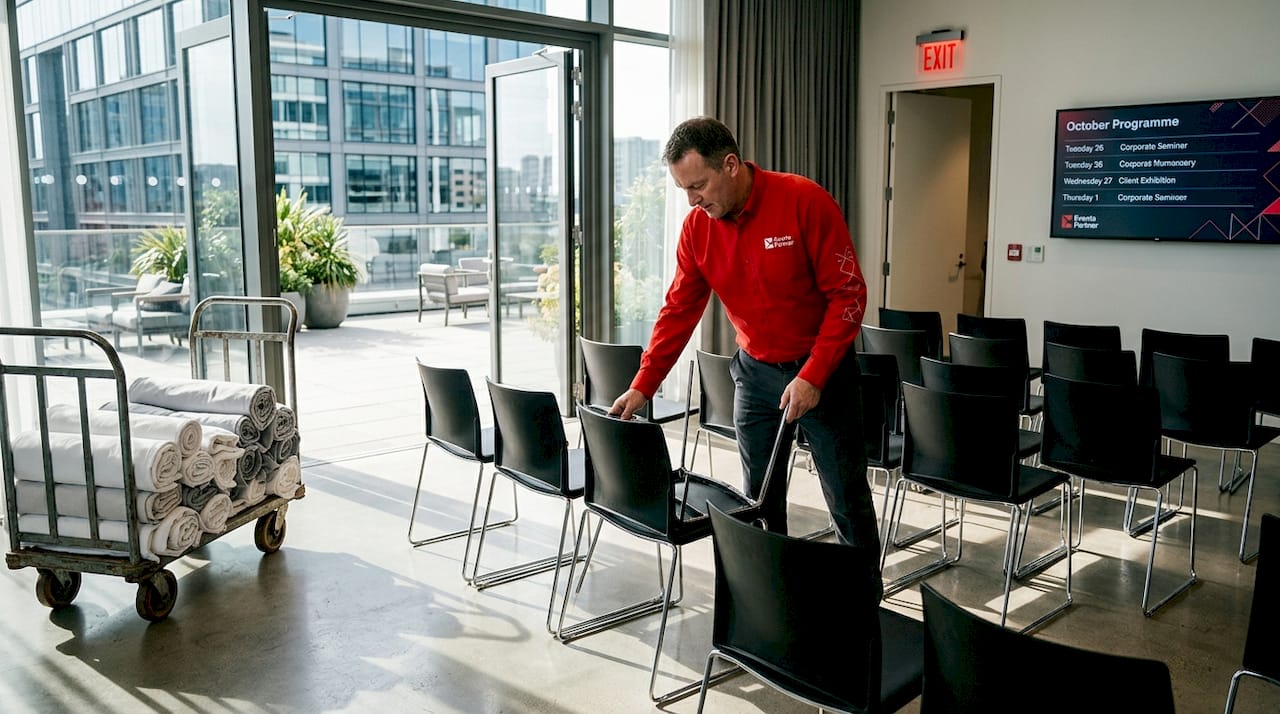
Weddings present a different challenge. The aesthetic expectations are high, the setup window is often short, and the couple’s vision may require furniture that the venue does not stock. Wedding furniture rental under a dry hire model works well when the planner has a detailed floor plan, a trusted setup crew, and a supplier who understands the style brief. Ghost chairs, Tiffany chairs, and lounge sets are popular dry hire choices for solemnisations and receptions, but they require precise placement and careful handling.
Exhibitions and trade shows demand furniture that can handle foot traffic, adapt to different booth configurations, and be repositioned quickly between sessions. Trade show furniture rental under dry hire gives exhibitors the flexibility to choose pieces that match their brand identity rather than accepting whatever the exhibition hall provides. The risk is that booth builders and furniture suppliers may have conflicting access windows, so coordination between vendors is critical.
Across all three event types, the planners who get the best results from dry hire are those who treat furniture logistics with the same rigour as AV or catering. The furniture is not a background detail. It shapes how guests move through the space, how long they stay in a zone, and how the event feels overall.
I have worked with enough Singapore event planners to know that dry hire catches people out in a very specific way. They budget for the venue fee and the furniture rental cost, then discover on event day that nobody arranged the setup crew, the delivery window clashes with the AV team’s access, or the venue’s included furniture does not match the floor plan at all.
The single most common mistake I see is treating dry hire as a product purchase rather than a service arrangement. You are not just buying chairs. You are contracting a logistics process, and every gap in that process is a problem you will solve under pressure on the day.
What I have found works well is a hybrid approach. Use dry hire furniture for the cost and flexibility benefits, but add setup and removal services from your supplier where possible. This keeps your costs lower than full wet hire while removing the heaviest operational burden from your team. Most reputable Singapore suppliers will accommodate this if you ask clearly.
Written confirmation of every inclusion and responsibility is non-negotiable. Not a WhatsApp summary. A proper written document. The events where I have seen the smoothest furniture logistics are always the ones where the planner sent a detailed brief, received a written confirmation back, and shared both documents with the venue manager before event week.
— Events
Eventspartner provides modern event furniture rental across Singapore for corporate events, conferences, exhibitions, weddings, gala dinners, and brand activations. Whether you need a full conference setup or a curated lounge arrangement for a product launch, the inventory is real, the pricing is transparent, and the logistics support is built in.
For corporate event furniture rental, Eventspartner offers delivery, setup, and removal as part of the service, so your team can focus on the event rather than the furniture logistics. Wedding planners, exhibition organisers, and venue managers across Singapore rely on Eventspartner for reliable, on-time delivery and a catalogue that covers every event format. Contact Eventspartner for a bespoke quote tailored to your event size, style, and venue requirements.
Dry hire event furniture means renting furniture without bundled staffing or operational support. Setup and operation are the planner’s responsibility to organise, though some suppliers offer setup as an optional add-on service.
Not necessarily. Some Singapore suppliers include delivery, setup, and removal even under dry hire terms. Always confirm in writing what is included before signing any hire agreement.
Dry hire typically has a lower base fee, but total event costs can be higher once you add external services such as setup crews, cleaning, and security. Budget for all additional costs before assuming dry hire is the more economical option.
Most dry hire venues provide basic furniture such as standard tables and chairs, but exclude catering, decoration, and production. Whether the default furniture suits your event layout requires separate assessment and may require additional hire.
For corporate events and weddings during peak periods, booking four to six weeks in advance is advisable. Popular items such as lounge sets, Tiffany chairs, and cocktail tables are reserved early, and early booking gives you the best selection and flexibility on quantities.



 Delivery Fees
 Payment Methods
 FAQ
FAQ