

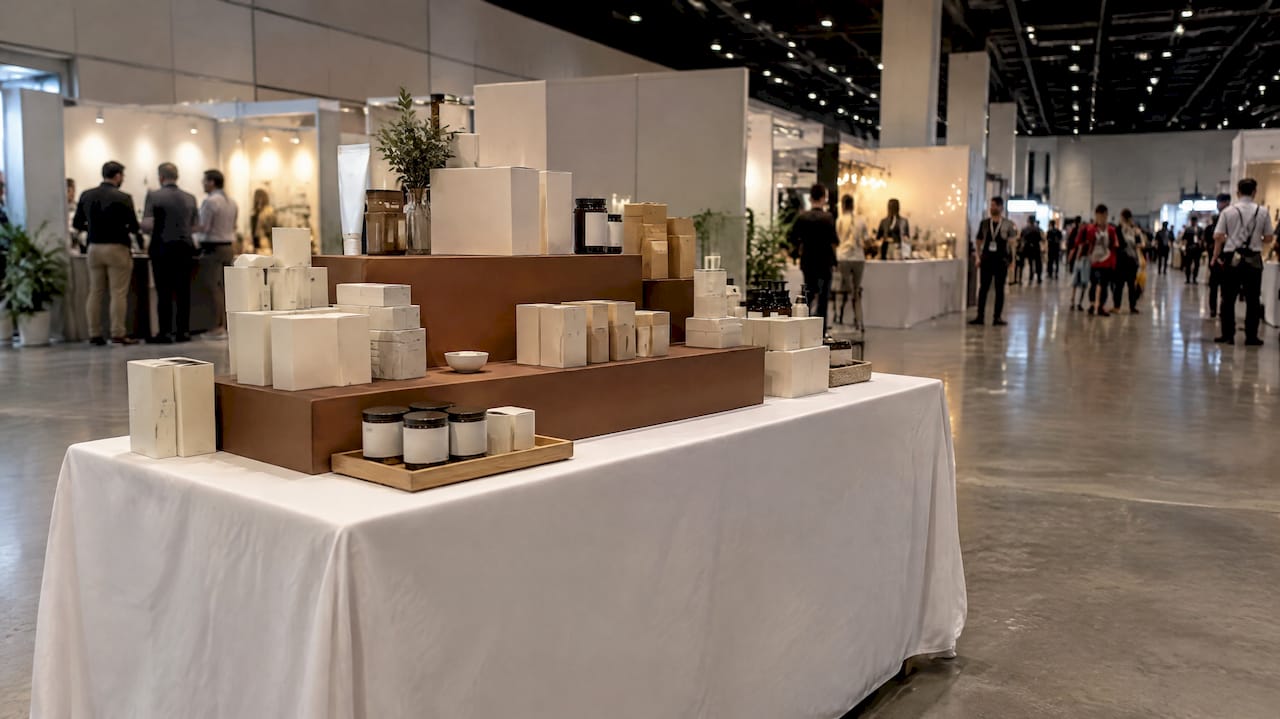
The right product display table depends on three things: the footprint you have, the height at which your product should be seen, and the weight it must carry. Get those right and the rest is styling. For Singapore exhibitions, launches and roadshows, we supply the tables, plinths and stands, deliver them, set them up and collect them afterwards, so the layout you plan is the layout your visitors see.
This guide covers the sizes planners ask about most, ideas that work for different products, and the checks to make before the furniture arrives.
Most display problems begin with buying or hiring the table first and then fitting the booth around it. Reverse that. The most common Singapore shell scheme booth is 3m × 3m, or 9 sqm, and a small footprint rewards an open layout that invites visitors in rather than a barrier of furniture at the front.
Sketch your booth to scale and mark three things:
We offer space planning and styling, so you can bring the floor plan and the product list and plan the furniture together before anything is booked.
Planners often ask for panel table dimensions. Standard trade show tables generally come in 6ft and 8ft lengths, about 2.5ft wide. The 6ft table is more compact and leaves space for other display items. The 8ft gives more surface for a bigger product range or signage.
| Format | Typical size | Best for |
|---|---|---|
| 6ft rectangular table | about 1.8m × 0.75m | Small booths, samples, brochures, tablet demos |
| 8ft rectangular table | about 2.4m × 0.75m | Larger ranges, product lines, signage at the back |
| Round or cocktail table | varies by model | Standing conversations, small hero products |
| Plinth or pedestal | see below | Single hero products, jewellery, devices |
The metric figures are conversions of the stated feet measurements. If you plan to dress the table with a custom cloth, match the cloth to the table size. A standard custom exhibition tablecloth in Singapore is 320 × 210 cm, cut for a 6-foot trestle, so confirm your table length before you order printing.
Browse our meeting and dining tables for work surfaces, and our cocktail, bar tables and counters when visitors will stand.
A plinth is a raised block or pedestal that lifts one product above the rest. It is the quickest way to give a launch product presence.

As a reference point, the ISAPS Singapore 2025 exhibitor manual lists system display plinths in three heights: 500mm, 750mm and 1000mm, each 500mm wide by 500mm deep. These are a useful guide to the proportions exhibitors commonly work with.
How to choose:
For a lit option, see our illuminated plinth bistro. For a stand-style display, look at the table stand and booth stand.
These ideas apply whether you are at a trade show, a mall atrium activation or a product launch.
Crates, clear acrylic blocks and small risers break up a flat surface. The pyramid approach is widely used: an asymmetrical arrangement with the key product at the top and a longer slope drawing the eye. It reads naturally and stops the table looking like a shelf.
Several small spotlights usually flatter products better than one large flood. Aim them at the top of the pyramid and let the edges fall off.
Visitors decide from the aisle. Put the main logo at visitor eye level on the front of the table and secondary information on the side panels. Design for legibility at two to three metres rather than fine detail that only reads up close. Before the doors open, walk to the aisle and look from about 5 metres: can you read the headline and logo, and does the booth look inviting?
A display that looks right but wobbles, or exceeds the floor rating, will be stopped by the venue. Singapore venue manuals put responsibility for structural safety on the exhibitor. For example, the BCB 2025 exhibitor manual says spreader plates are needed if a static display exceeds 12 kN/m² (1,250 kg/m²) floor loading, and that demonstrated machinery must be secured against slipping and kept out of aisles. Another event’s manual sets a maximum booth wall height of 2.20m and a floor load of 488 kg per square metre. Limits differ by venue and show, so read the manual for your own event.
A short pre-order checklist:
For compliance specifics, read our event furniture safety checklist. If the venue protects its floors, see event floor protection.
A display draws people in, but a place to sit keeps the conversation going. Short meeting points of a few minutes need little: a pair of stools or a small side table. For longer client discussions, a compact lounge works. Our guides on trade show furniture ideas and exhibitor lounge furniture show how to size these. Contractors building several booths can also read about exhibition contractor furniture rental.

The furniture is only part of the cost; delivery timing matters too. Our published delivery and setup or teardown fees are per truck, per trip:
| Time window | Standard (14ft), orders up to S$999.99 | Standard (14ft), orders S$1000 and above | Heavy (24ft), orders S$1000 and above |
|---|---|---|---|
| Office hours | S$60 | from S$65 | from S$130 |
| After office hours | S$120 | from S$130 | from S$260 |
| Night shift hours | S$180 | from S$195 | from S$390 |
A stairs surcharge of 50% and a same-venue turnover fee from 20% may apply. Details are on our delivery and setup fees page. Many halls only allow loading in the evening or overnight, so check your load-in slot early and price the right row.
We rent event furniture in Singapore for exhibitions, launches, roadshows, weddings and corporate functions, with delivery, setup and collection included in the service. Our range covers tables, bar tables, stools, sofas and coffee tables, and we can add custom sticker branding and space planning and styling.

Start with the exhibitions and tradeshows range, or for premium showcases the luxury exhibitions collection. When your list is ready, request a quotation through our Events Partner site.
A 6ft table is usually the safer choice, as it leaves open floor for visitors and room for a plinth or stand. An 8ft table suits a wider product range or signage, but takes more of a 9 sqm footprint.
Common system plinths come in 500mm, 750mm and 1000mm, each 500mm square. Choose lower for large items, mid-height for hands-on products and tall for small, high-value pieces that need to sit near eye level.
Vary the heights with risers, put the hero product at the top of an asymmetrical pyramid, and use several small spotlights. Place the logo at eye level on the front of the table so it reads from the aisle.
Yes. Singapore venue manuals make exhibitors responsible for structural safety, and some set floor loading limits and require proof of load-bearing capacity. Weigh your heaviest item and check the manual for your event.
#ProductDisplay #ExhibitionFurniture #TradeShowSingapore #EventFurnitureRental #BoothDesign



 Delivery Fees
 Payment Methods
 FAQ