Event furniture categories explained: a planner’s guide
July 10, 2026
Event furniture categories are defined as the distinct groups of seating, tables, and specialty pieces that together shape the physical environment of any event. For event organisers in Singapore, getting this right matters from the first planning call. The wrong chair at a gala dinner or the wrong table height at a networking session can undermine an otherwise well-run event. This guide covers every major furniture category, with hire cost benchmarks, layout standards, and selection criteria drawn from real event planning practice. Whether you are setting up a corporate conference at Suntec City, a wedding at a hotel ballroom, or an exhibition at Marina Bay Sands, understanding these categories is the foundation of a well-executed setup.
What are the main event furniture categories explained?
Event furniture categories fall into three primary groups: seating, tables, and specialty items. Each group contains distinct sub-types suited to specific event formats, guest volumes, and venue conditions. Planners who understand these distinctions make faster decisions and avoid costly last-minute changes.
The three categories work together rather than in isolation. A corporate conference needs conference chairs, folding tables, and a lectern. A gala dinner needs banquet chairs, round dining tables, and a mobile bar. A trade show needs exhibition counters, poseur tables, and lounge clusters. Matching the right category to the right event type is the core skill this guide develops.
What are the main seating options for events and when should you choose each?
Seating is the most visible furniture category at any event. The chair type sets the tone before a single guest sits down. Hire costs vary widely by chair type, from folding chairs at the budget end through to Chiavari chairs at the premium end, which means your seating choice also shapes your overall furniture budget.
Folding chairs
Folding chairs are the workhorse of the events industry. They are lightweight, stack easily, and suit high-volume setups such as roadshows, community events, and conference breakout rooms. They are not suited to formal dinners or VIP settings where guest comfort and visual impression carry more weight.
Banquet chairs
Banquet chairs are padded, upholstered seats designed for long events where guests remain seated for extended periods. They are the standard choice for gala dinners, award ceremonies, and hotel ballroom events. Their padded seat and back make them comfortable for two to three hours of seated dining, which folding chairs cannot match.
Chiavari chairs
Chiavari chairs, also called Tiffany chairs in Singapore, are the preferred choice for weddings, solemnisation setups, and premium corporate dinners. Their slim profile and elegant appearance photograph well and suit both indoor and outdoor settings. They require more careful handling than folding or banquet chairs, so supplier condition matters more with this type.
Lounge seating
Lounge seating includes sofas, armchairs, ottomans, and bench seats arranged in clusters. This format suits networking events, VIP lounges, brand activations, and cocktail receptions. Standing networking events typically require seating for only 20–40% of guests, with the remainder standing at poseur tables or moving freely. That ratio guides how much lounge seating to order relative to total guest count.
Pro Tip:For networking events, resist the urge to fill the room with chairs. Lounge clusters of two to four seats with a low coffee table in between encourage conversation far better than rows of chairs.
Key seating considerations for Singapore planners:
Aisle width: Maintain a minimum 60-inch (5-foot) aisle between seating rows for safe circulation and emergency egress.
Chair spacing: Allow 50–75 cm of clearance behind each chair for guests to push back and stand comfortably.
Material: Outdoor events in Singapore’s humidity require chairs with rust-resistant frames and UV-stable finishes.
Condition: Visibly worn chairs damage the professional impression of an event more than any other single furniture fault.
What types of event tables are there and how do you choose the right one?
Tables define the functional layout of an event. The shape, height, and size of a table determine how guests interact, how food is served, and how the room flows. Furniture choice varies by venue type: wedding venues prioritise elegance, conference centres prioritise durability, and hotel ballrooms require versatility across both formats.
Round banquet tables
Round tables seat 8–10 guests and are the standard for gala dinners, wedding receptions, and corporate award nights. They encourage conversation across the table and suit Chinese banquet-style dining, which is common at Singapore hotel ballrooms. A 60-inch (5-foot) round table seats 8 guests comfortably; a 72-inch (6-foot) round seats 10.
Rectangular trestle tables
Rectangular trestle tables suit buffet lines, registration counters, seminar layouts, and exhibition setups. They are modular by nature, meaning you can arrange them in rows, U-shapes, or boardroom configurations. Their flat surface also makes them practical for product display at trade shows and roadshows.
Poseur tables and cocktail tables
Poseur tables, also called cocktail tables or bar tables, are tall standing-height tables used at networking events, cocktail receptions, and exhibition floors. They encourage brief, standing conversations and help manage crowd flow in open-plan spaces. Hire costs for poseur tables sit in a higher range than standard dining tables, reflecting their specialist use.
Exhibition counters
Exhibition counters are purpose-built display surfaces used at trade shows, product launches, and brand activations. They often include built-in shelving, lockable storage, or branded panel options. Their modular construction makes them practical for venues with restricted loading access, such as mall atriums or convention centre halls.
Table type
Best suited for
Key advantage
Round banquet table
Gala dinners, weddings
Encourages conversation; suits Chinese dining
Rectangular trestle
Seminars, buffets, exhibitions
Modular; easy to reconfigure
Poseur/cocktail table
Networking, cocktail receptions
Manages crowd flow; space-efficient
Exhibition counter
Trade shows, product launches
Built-in storage; branded panel options
Pro Tip:Always calculate your table footprint first, then add a 20–30% buffer for circulation, waitstaff access, and fire safety compliance. Planners who skip this buffer routinely find their layouts fail venue safety checks on the day.
What specialty event furniture categories enhance the guest experience?
Specialty furniture sits outside the standard seating and table categories but plays a decisive role in shaping the atmosphere and function of an event. Guest experience at hospitality events depends heavily on how well these pieces integrate with the main furniture layout.
Mobile bars
A mobile bar is a freestanding counter unit used at cocktail receptions, gala dinners, and brand activations. It creates a focal point in the room and manages guest flow by drawing people toward a defined service area. Mobile bars are available in straight, curved, and L-shaped configurations to suit different venue layouts.
Lounge clusters
A lounge cluster is a curated grouping of sofas, armchairs, and low tables arranged to create a defined social zone within a larger event space. They are standard at VIP lounges, networking events, and media launches. Modular lounge furniture with disassembly capability reduces transport and setup time significantly, which matters for venues with restricted loading access such as Orchard Road mall atriums.
Display and staging furniture
Display furniture includes product pedestals, display shelves, and branded counters used at exhibitions and product launches. Staging furniture includes rostrums, lecterns, and presentation tables used at conferences and award ceremonies. These pieces anchor the front-of-room experience and must be sized correctly relative to the stage or presentation area.
Pro Tip:Request supplier photos of specialty pieces before confirming your order. Assessing furniture condition from photos before delivery prevents the unpleasant surprise of worn or mismatched pieces arriving on setup day.
Specialty furniture considerations:
Confirm modular construction for pieces that need to fit through narrow venue access points.
Check that mobile bars and exhibition counters include levelling feet for uneven outdoor surfaces.
Lounge clusters work best when positioned away from main traffic routes to create a sense of arrival and separation.
Rostrums and lecterns must match the stage height and AV setup to avoid sightline issues for seated guests.
How do you choose the right event furniture for your event?
Selecting furniture for an event requires a structured approach. Four pillars guide every decision: aesthetic suitability, spatial dimensions, material durability, and transportability. Planners who apply all four consistently avoid the most common setup failures.
Assess aesthetic suitability. The furniture style must match the event’s visual identity. Chiavari chairs suit a wedding or gala; folding chairs suit a community seminar. Mismatched aesthetics undermine the event’s brand impression regardless of how well everything else is executed.
Measure spatial dimensions accurately. Obtain the venue’s floor plan and calculate the furniture footprint before ordering. Add a 20–30% buffer beyond the furniture area for aisles, fire exits, and waitstaff movement. For corporate event furniture, this buffer is non-negotiable at venues like Suntec Convention Centre, which enforces strict aisle-width requirements.
Prioritise material durability. High-rotation rental furniture must meet commercial-grade durability standards. Singapore’s climate adds humidity and heat stress to outdoor pieces, so frame material and finish quality matter more here than in temperate climates. Ask your supplier directly about the maintenance cycle for each piece.
Evaluate transportability. Furniture that disassembles quickly reduces setup time and logistics costs. This is especially relevant for conference furniture at venues with limited loading bay access or tight turnaround windows between events.
Verify supplier reliability. Reliable delivery and after-sales support prevent schedule disruptions regardless of furniture quality. Confirm delivery windows, on-site setup support, and replacement protocols before signing any rental agreement.
Match furniture to the event’s primary function. A wedding furniture setup prioritises elegance and photographic appeal. An exhibition setup prioritises modularity and brand visibility. A conference setup prioritises comfort for extended seated sessions. Each function demands a different weighting of the five factors above.
Key takeaways
Choosing the right furniture category is the single most consequential planning decision an event organiser makes, because it determines guest comfort, venue compliance, and the overall visual impression of the event.
Point
Details
Three primary categories
Event furniture divides into seating, tables, and specialty items, each with distinct sub-types.
Seating sets the tone
Chair type signals event formality and directly affects guest comfort over long sessions.
Tables define function
Table shape and height determine how guests interact, dine, and move through the space.
Specialty pieces shape atmosphere
Mobile bars, lounge clusters, and display counters create focal points and manage crowd flow.
Four selection pillars
Evaluate aesthetics, dimensions, durability, and transportability before confirming any rental order.
What experienced planners know that first-timers often miss
The furniture category decision looks straightforward on paper. In practice, the mistakes happen in the gaps between categories. A planner orders the right chairs and the right tables, then forgets that the combined footprint leaves no room for waitstaff to move. Or they select beautiful Chiavari chairs for an outdoor garden wedding, only to find the legs sink into soft ground without chair caps.
The detail that catches most planners off guard is the circulation buffer. Real furniture footprints are always larger than the nominal dimensions on a spec sheet. A 60-inch round table for 8 guests needs roughly 5 feet of clearance on every side for guests to sit, stand, and move. That adds up fast in a 400-square-metre ballroom. I have seen layouts that looked perfect on a floor plan become genuinely unsafe once the furniture was in place.
The other underestimated factor is furniture condition. Style is the first thing planners focus on, and condition is often the last. A scratched exhibition counter or a stained lounge sofa does more damage to a brand’s impression than a slightly less fashionable chair choice would. Always request photos of the actual pieces you will receive, not catalogue images. Suppliers who maintain their inventory properly will send those photos without hesitation.
The most effective approach I have seen is to plan furniture categories in reverse: start with the event’s primary function, then work backwards to the furniture that serves it. A product launch is about brand visibility first, so the exhibition counter and display furniture take priority. A gala dinner is about the dining experience first, so the banquet chair and round table combination takes priority. Every other piece supports those anchors.
— Events Partner
Planning your next event with Events Partner
Events Partner provides event furniture rental across every category covered in this guide, from Chiavari chairs and banquet seating through to modular lounge clusters, poseur tables, mobile bars, and exhibition counters. Every piece in the inventory is maintained to commercial-grade standards, with transparent pricing and reliable delivery across Singapore.
Whether you are planning a corporate conference, a wedding solemnisation, or a trade show at an exhibition hall, Events Partner’s team can help you match the right furniture categories to your venue dimensions, guest count, and event format. The 2026 planning guide covers rental logistics, layout planning, and category selection in detail. Reach out to Events Partner to discuss your next event setup.
FAQ
What are the three main event furniture categories?
Event furniture categories are seating, tables, and specialty items. Each category contains distinct sub-types suited to specific event formats, from folding chairs for seminars to Chiavari chairs for weddings and exhibition counters for trade shows.
How much space should I allow per guest for event furniture?
Add a 20–30% buffer beyond your furniture footprint for aisles, fire exits, and waitstaff movement. Maintain a minimum 60-inch aisle width between seating rows for safe circulation.
What is the difference between a poseur table and a banquet table?
A poseur table is a tall, standing-height table used at networking events and cocktail receptions. A banquet table is a standard dining-height table used for seated meals at gala dinners and wedding receptions.
When should I use lounge furniture at an event?
Lounge furniture suits networking events, VIP lounges, brand activations, and cocktail receptions. For standing events, plan lounge seating for 20–40% of your guest count and fill the remainder with poseur tables and open floor space.
How do I verify furniture condition before my event?
Request photos of the actual rental pieces before confirming your order. Suppliers who maintain their inventory to commercial-grade standards will provide these without hesitation, and visible wear on chairs or counters is a clear signal to look elsewhere.


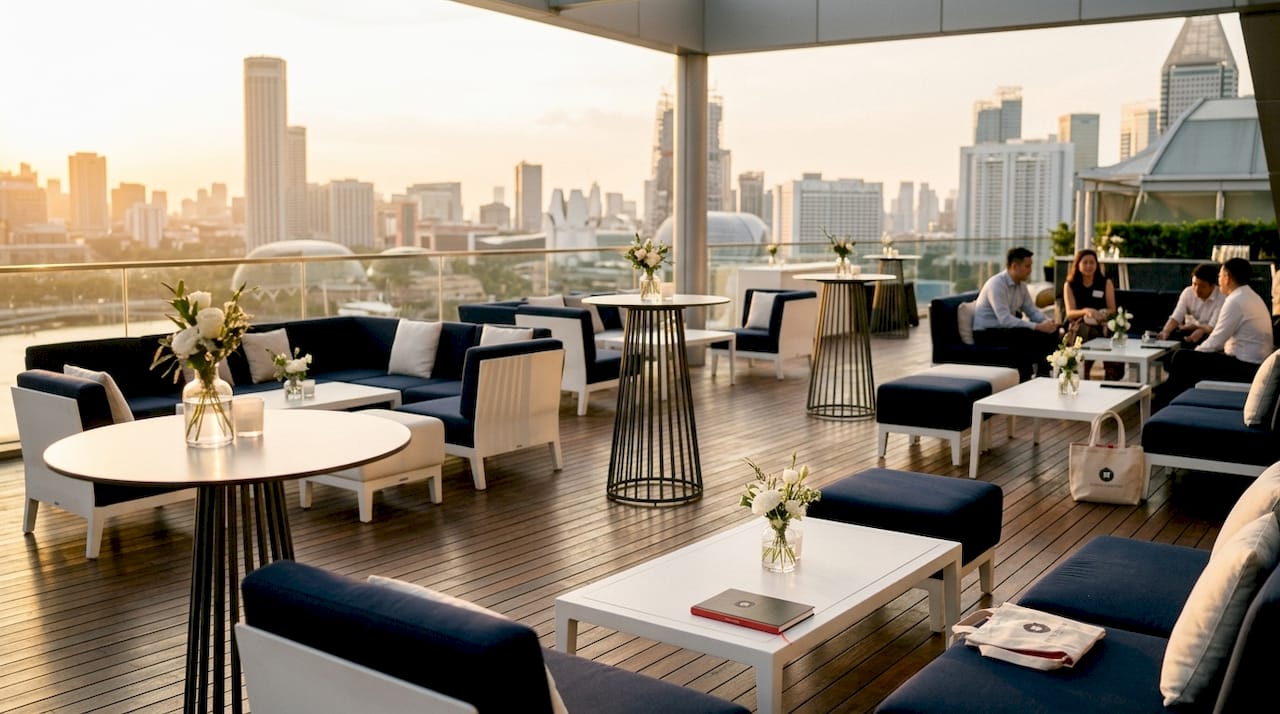
 The three categories work together rather than in isolation. A corporate conference needs conference chairs, folding tables, and a lectern. A gala dinner needs banquet chairs, round dining tables, and a mobile bar. A trade show needs exhibition counters, poseur tables, and lounge clusters. Matching the right category to the right event type is the core skill this guide develops.

 Whether you are planning a corporate conference, a wedding solemnisation, or a trade show at an exhibition hall, Events Partner’s team can help you match the right furniture categories to your venue dimensions, guest count, and event format. The 2026 planning guide covers rental logistics, layout planning, and category selection in detail. Reach out to Events Partner to discuss your next event setup.



 Delivery Fees
 Payment Methods
 FAQ
FAQ