

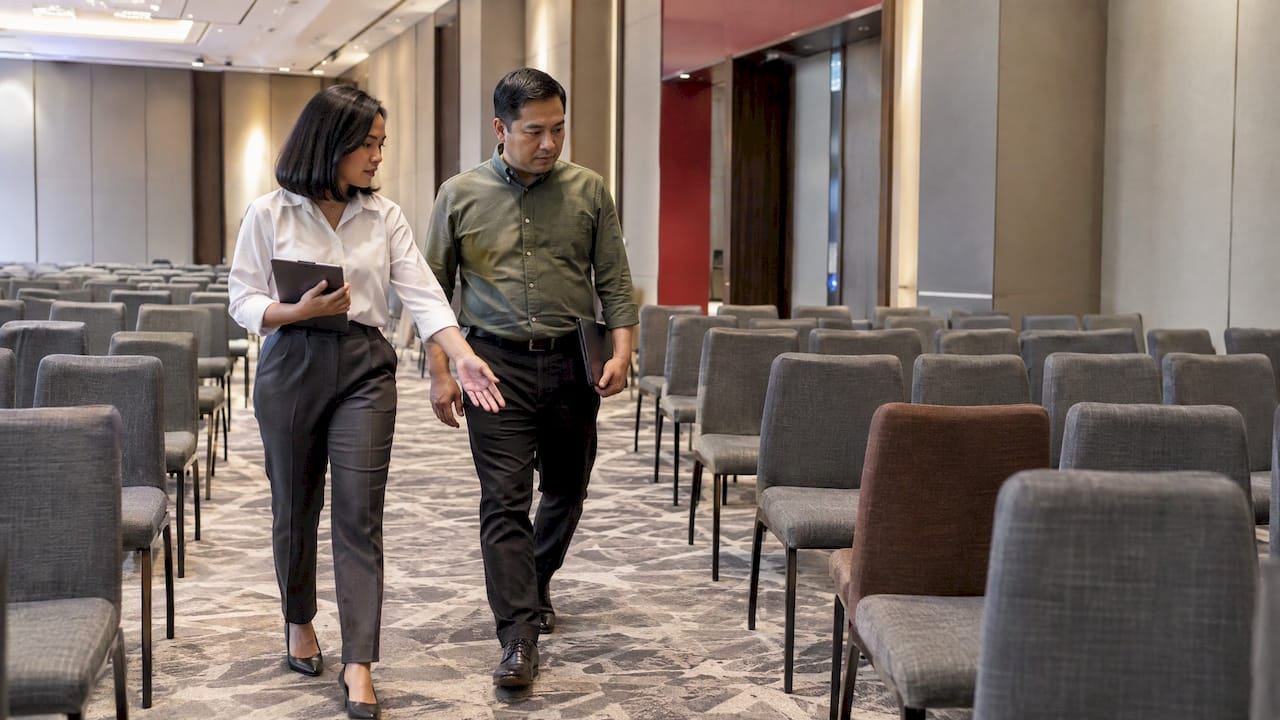
An event furniture risk assessment is a written check, done before work starts, of what could injure people or block escape routes when furniture is delivered, set up, used and cleared. In Singapore the method comes from the Workplace Safety and Health (WSH) framework: list the hazards, score them, control the worst first, record it and review it. The easiest way to keep that assessment short and accurate is to work with a furniture supplier that delivers, sets up and collects as one operation, because fewer hands and fewer handovers mean fewer hazards to score. That is how we work at Events Partner.
Furniture looks harmless next to rigging, staging or tents. It is not. Chairs and tables are carried in volume, through loading bays and lifts, by crews working to a tight load-in window. Once placed, they decide how guests move and how quickly a room can empty.
The WSH Council’s guidance for event management says employers should provide a safe environment for employees and visitors, suitable safety measures, emergency response systems, and sufficient instruction, training and supervision. It also expects risk assessments to identify hazards and the measures that address them.
The legal basis is the Workplace Safety and Health (Risk Management) Regulations, which cover risk assessment, elimination and control of risks, records, provision of information and review. The 2022 WSH guidance for hospitality and entertainment states that assessment and controls are required before the work activity begins, and recommends consulting contractors and suppliers.
In practice, that means three parties each hold part of the picture: you as organiser, the venue, and the furniture supplier. A good assessment brings the three together on one page.
Do not write one generic “furniture” line. Split the work the way the day actually runs.
The hazards here are manual handling, vehicle movement at the loading bay, narrow lifts, ramps and stairs. Singapore Standard SS 569, the code of practice for manual handling, covers hazard identification, risk assessment, risk control and training for lifting and carrying, and includes a sample hazard-identification checklist.
Questions to settle with the venue: which loading bay, what height clearance, is there a goods lift, how far is the carry, and what are the permitted hours? Stairs and long carries raise manual handling risk, and they also raise cost. Our delivery and setup fee schedule lists a 50% stairs surcharge, so flagging stairs early protects both safety and budget.
This is where most furniture-specific risk lives. Check that:
The SCDF amendments to the Fire Code, effective 2 March 2025, specify a 1-metre clearance at fire-access openings. Furniture placement can therefore affect fire-service access as well as guest circulation. Our guide to event furniture compliance for SCDF goes deeper into layout checks.
Slippery or delicate floors add another hazard. Plan protection early; our page on event floor protection covers the options.
The people exposed now are guests, not crew. Think about guests who are elderly, pregnant, children, or using mobility aids. Consider high bar stools next to walkways, low sofas that are hard to rise from, loose chairs near stage edges, and tables with sharp corners at head height in crowded networking rooms. Staff roaming with trays are exposed too.
Teardown is often rushed and done late at night, with tired crews and guests’ belongings still around. Assess stacking height, trolley routes, and who has authority to stop the work. Fees differ by time band, with office hours, after office hours and night shift hours priced differently on our schedule, so planning teardown inside a sensible window is also a safety choice.
For each activity, ask what injury or ill health could result and who could be affected. Consider the physical environment, how the work is organised, and individual factors such as health or experience.
The WSH event guideline then scores severity and likelihood on a scale of 1 to 5 and multiplies them into a Risk Prioritisation Number, checked against a 5×5 matrix. Higher scores get attention first.

Worked example. Chairs are stacked in a corridor that leads to a fire exit during setup. Severity if a crowd must evacuate: 4. Likelihood given a busy load-in: 3. The score is 12, which is high enough to need action before work continues. Moving the stack to a staging bay lowers likelihood to 1, and the score drops to 4.
The guidance follows the hierarchy of control, which the WSH tent-related works guidelines also set out: elimination, substitution, engineering controls, administrative controls, then personal protective equipment.
For furniture, that looks like this:
| Level | Furniture example |
|---|---|
| Elimination | Remove the stack from the corridor; skip a heavy item the lift cannot take |
| Substitution | Use stackable or lighter chairs instead of heavy banquet chairs for a long carry |
| Engineering | Trolleys, dollies and floor protection |
| Administrative | Load-in schedule, toolbox briefing, marshalled routes |
| PPE | Gloves and safety shoes for crew |
The WSH guidance points to the following fields. Copy them into whatever format your company uses.
On the day, verify that equipment and loads are in good condition, routes are stable and clear, furniture is undamaged, operators are competent, PPE is suitable, a toolbox briefing has been held, housekeeping is under control and exits are clear.
Complete the assessment before work begins. Review it regularly and whenever the work or conditions change: a venue switches the loading bay, the guest count jumps, or the layout is revised. The Risk Management Regulations include a section on review of risk assessment. The WSH event guideline says records must be available on request and kept for at least three years.
The WSH Council recommends consulting contractors and suppliers because delivery, venue access, setup and dismantling are shared activities. Practical steps:
For wider coordination across venue teams, furniture suppliers and contractors, this site inspection checklist is a handy companion to your own template.
For more on this, see how experienced furniture suppliers reduce on-site event risks and our guide to reducing setup risk for planners.
We rent chairs, tables, sofas, cocktail and bar tables, barstools and coffee and side tables, with delivery, setup and collection included in the rental. We also offer space planning and styling, which helps you settle aisles, exits and clearances before the layout is locked. Our fees are published: for example, office-hours delivery and setup in a standard 14ft truck is S$60 per truck per trip for orders up to S$999.99, so you can cost the load-in as part of your plan.

Browse chairs and meeting and dining tables, or send your layout through Events Partner to get a quotation and plan the furniture side of your risk assessment with us.
The WSH (Risk Management) Regulations require risk assessment for workplace activities, and the WSH Council’s hospitality and entertainment guidance states it must happen before the work activity begins. Furniture delivery, setup and teardown are work activities, so they belong inside your assessment.
The WSH Council event guideline says records must be available on request and retained for at least three years. Keep the scored assessment, the review notes and the briefing records together.
Review it regularly and whenever work or conditions change, such as a new venue access route, a revised layout or a change in headcount. Update it before the changed work starts.
The venue, your furniture supplier and any other contractors sharing the space. The WSH Council recommends consulting contractors and suppliers because load-in, setup and dismantling involve several parties at once.



 Delivery Fees
 Payment Methods
 FAQ