Events offices and temporary setups: a complete guide
June 21, 2026
A complete guide for events offices and temporary setups begins with one clear principle: the physical workspace you build around your event is just as important as the event itself. In Singapore, where corporate conferences, trade shows, and gala dinners run back to back across venues like Suntec City, Marina Bay Sands, and Changi Exhibition Centre, a poorly planned temporary office creates delays before the first guest arrives. This guide covers the full planning cycle, from spatial design and permit timelines to furniture rental coordination and common mistakes that cost planners time and money.
What are the main planning stages for events offices and temporary setups?
The planning timeline is the single most important document you will produce for any event office or temporary setup. Starting at least six months ahead reduces last-minute stress significantly, and the majority of experienced event planners in Singapore recommend this lead time for large-scale executions. The reason is simple: every delay in the early stages compounds into a crisis in the final two weeks.
A phased approach works best. Break your timeline into four stages:
Months six to four before the event. Lock in your venue, confirm the floor plan, and begin permit applications. In Singapore, permit submissions for large-scale events should be submitted 2–16 weeks before the event date, depending on scale and venue type. Venue bookings should be confirmed 8–10 weeks before move-in. Start this process early to avoid clashes with other events at the same venue.
Months four to two before the event. Finalise your site layout, confirm all suppliers, and sign contracts. Delaying vendor contracts causes chaos in the final two weeks of execution. This is the stage to confirm your furniture rental order, IT equipment, and power requirements in writing.
Weeks eight to two before the event. Coordinate delivery schedules, run a site walkthrough, and test all technical systems. Pre-configure IT hardware and test internet connectivity on site. Skipping on-site testing causes day-one technical downtime even when hardware setup is otherwise quick.
Final two weeks. Focus on execution, not planning. Any changes at this stage cost more and carry higher risk. Brief your on-site team, confirm delivery windows with your furniture rental provider, and prepare a contingency plan for weather, access delays, or supplier issues.
Budget planning runs parallel to this timeline. Every event budget needs a contingency of 10–15% for unpredictable costs. For temporary office setups in Singapore, this buffer typically covers last-minute furniture additions, extended rental periods, and access surcharges at certain venues.
Pro Tip:Book your furniture rental and IT equipment at the same time as your venue. Suppliers in Singapore fill up quickly during peak MICE season, particularly between september and november.
How do you design and organise the physical space for event offices?
Space planning for a temporary event office is a discipline in its own right. The standard for productive temporary workspaces is 5–7 square metres per person, with one dedicated meeting area for every 10–12 staff members. In practice, most planners underestimate how much space a working event office actually needs once you factor in equipment, storage, and movement.
Traffic flow matters more than raw square footage. Mapping traffic flow prevents bottlenecks that slow down operations even when the headcount fits the space. In a typical event office at a Singapore convention centre, the most common bottleneck is the entrance zone, where staff, vendors, and couriers all converge. Separate these flows on your floor plan before you place a single piece of furniture.
The table below shows how space usage changes across common event types in Singapore:
Event type
Recommended office size
Key furniture needs
Priority zone
Corporate conference (100–300 pax)
40–60 sqm
Desks, chairs, meeting table, storage
Briefing area
Trade show or exhibition
20–40 sqm
Counter tables, bar stools, display shelving
Registration counter
Gala dinner or awards night
15–25 sqm
Lounge seating, work desks, AV station
Backstage coordination
Roadshow (mall atrium)
10–20 sqm
Folding tables, chairs, branded counter
Client-facing counter
Power zone planning is a step most planners skip until it is too late. Pre-mapping power outlet zones before furniture arrives prevents extension cord hazards and workflow delays. Decide where your computers, printers, charging stations, and AV equipment will sit, then confirm power points are accessible at those exact locations. Do this before the furniture arrives, not after.
Pro Tip:Ask your venue for a power point map before your site visit. Cross-reference it with your furniture layout so you never discover a mismatch on setup day.
What are the best practices for furniture rental and logistics in temporary setups?
Furniture rental is the most practical solution for temporary event offices in Singapore. Purchasing furniture for a three-day conference makes no financial sense. Rental gives you access to the right pieces for the right duration, with delivery, setup, and collection handled by the provider.
The key is matching furniture type to function. A registration counter needs a high bar table and stools. A briefing room needs a rectangular conference table with upright chairs. A VIP holding area needs lounge seating. Mixing these up creates an office that looks wrong and works worse.
Event office zone
Recommended furniture
Rental benefit
Registration and check-in
Bar tables, counter stools, signage stands
Quick setup, branded finish options
Staff workstation area
Desks, ergonomic chairs, cable management
Flexible quantity, short-term hire
Meeting and briefing room
Conference table, chairs, whiteboard
Modular sizing for room dimensions
VIP or client lounge
Lounge sofas, coffee tables, side tables
Premium finish, easy reconfiguration
Backstage coordination
Folding tables, stackable chairs, trolleys
Fast pack-down, compact storage
Logistics coordination is where many setups fail. For multi-venue furniture delivery, the critical variable is access time. Singapore venues like Suntec City and Marina Bay Sands have strict loading bay windows. Miss your window and your furniture sits in a lorry while your team scrambles.
Key logistics practices for Singapore event offices:
Confirm loading bay access times with the venue at least four weeks before the event.
Schedule furniture delivery at least one day before the event opens, not on the morning of.
Assign one person on your team as the sole point of contact for the rental provider.
Confirm the collection schedule in writing before setup begins, not after the event ends.
For fast-turnaround events, brief your rental provider on the exact pack-down sequence so they can work alongside your team.
The best rental providers in Singapore offer transparent pricing with no hidden surcharges for standard delivery windows. Confirm this before signing any rental agreement.
What are the common pitfalls in managing temporary event offices?
The most expensive mistakes in temporary event office management are not dramatic failures. They are small oversights that compound into operational problems on the day.
The most common pitfalls, and how to avoid them:
Power planning left too late. Most planners finalise their furniture layout before checking power point locations. The result is extension cords running across walkways, which creates safety hazards and fails venue compliance checks. Fix this by mapping power zones on your floor plan before confirming furniture positions.
Underestimating setup lead time. A 40 sqm event office with furniture, IT equipment, and signage takes longer to set up than most planners expect. Budget at least four hours for a standard setup, and double that for complex multi-zone offices. Arriving on the morning of the event to set up is a risk you should never take.
Ignoring traffic flow. A room that fits 20 people can still feel chaotic if everyone enters and exits through the same narrow point. Draw your traffic flow on paper before you finalise the layout. Separate staff entry from client-facing zones wherever the venue allows.
Booking furniture too late. In Singapore, peak MICE season runs from september through november, and again in march and april. Rental inventory fills up. Planners who confirm furniture orders less than two weeks before their event often find their preferred pieces unavailable.
No contingency plan for furniture damage or missing items. Confirm with your rental provider what happens if a piece arrives damaged or a quantity is short. A good provider will have a replacement protocol. Know it before setup day, not during it.
Do’s and don’ts for Singapore event office managers:
Do confirm all supplier contracts at least eight weeks before the event.
Do assign a dedicated logistics coordinator for the setup and pack-down phases.
Do walk the venue with your floor plan in hand before finalising any layout.
Don’t assume the venue will provide power boards, extension cords, or cable covers.
Don’t leave furniture rental confirmation until the final month of planning.
Don’t rely on verbal agreements with suppliers for delivery times or quantities.
Key takeaways
Effective temporary event office management requires early planning, precise spatial design, and confirmed logistics well before the event date.
Point
Details
Start planning early
Begin at least six months ahead to avoid last-minute supplier and permit issues.
Plan space by function
Allocate 5–7 sqm per person and separate zones by role to maintain flow.
Map power zones first
Confirm power point locations before placing furniture to avoid safety hazards.
Book furniture rental early
Confirm rental orders at least eight weeks ahead, especially during peak MICE season.
Build in a budget buffer
Reserve 10–15% of your event budget for unexpected costs and last-minute changes.
What I have learned from managing setups across Singapore venues
After working across venues from Suntec City to Changi Exhibition Centre, the pattern is consistent: the setups that run smoothly are never the ones with the biggest budgets. They are the ones where the planner made decisions early and stayed flexible on the day.
The advice to start with a solid plan but stay flexible on-site sounds obvious until you are standing in a loading bay at 7am with a furniture delivery that is 20 minutes late and a venue access window that closes at 8am. Planning gives you the margin to absorb that. No planning means that 20-minute delay becomes a full-day crisis.
The other thing most guides do not say clearly enough: your furniture rental provider is a logistics partner, not just a supplier. The difference matters. A partner knows your venue’s loading bay rules, can advise on layout based on experience, and will flag problems before they become yours. Choose on that basis, not just on price.
Singapore’s event industry moves fast. Venues book up, suppliers fill their calendars, and the planners who treat their temporary office setup as an afterthought are the ones who end up improvising on the day. Treat the office as part of the event. It is where your team operates, where your clients form their first impression, and where the entire production is coordinated from.
— Events Partner
Plan your next event office with Events Partner
Events Partner supplies modern event furniture for temporary offices and event setups across Singapore, covering corporate conferences, trade shows, roadshows, gala dinners, and product launches. The catalogue includes conference tables, workstation desks, lounge seating, bar tables, counter stools, and branded display pieces, all available on flexible short-term rental periods. Delivery, setup, and collection are coordinated to fit your venue’s access windows. For conference and large-scale setups, Events Partner provides inventory planning support so your office is ready before your team arrives. Contact Events Partner for a quote or visit the website to browse the full catalogue.
FAQ
How far in advance should I book furniture for a temporary event office?
Book at least eight weeks before your event, and earlier during Singapore’s peak MICE season from september to november. Late bookings risk unavailability of key pieces.
What is the standard space allowance for a temporary event office?
The industry standard is 5–7 square metres per person, with one meeting area for every 10–12 staff members. This applies to corporate event offices in Singapore convention centres and hotel ballrooms.
Why does traffic flow matter more than room size in temporary setups?
A room can meet headcount requirements but still create bottlenecks if entry, exit, and work zones overlap. Mapping movement patterns on your floor plan before finalising the layout prevents this.
What should I include in an event office setup checklist?
A complete checklist covers: floor plan with power zones marked, furniture rental confirmation, IT equipment pre-configuration, loading bay access times, delivery and collection schedule, and a contingency plan for missing or damaged items.
How much budget contingency should I set aside for a temporary event setup?
Reserve 10–15% of your total event budget for unexpected costs. This covers last-minute furniture additions, extended rental periods, and access surcharges at Singapore venues.



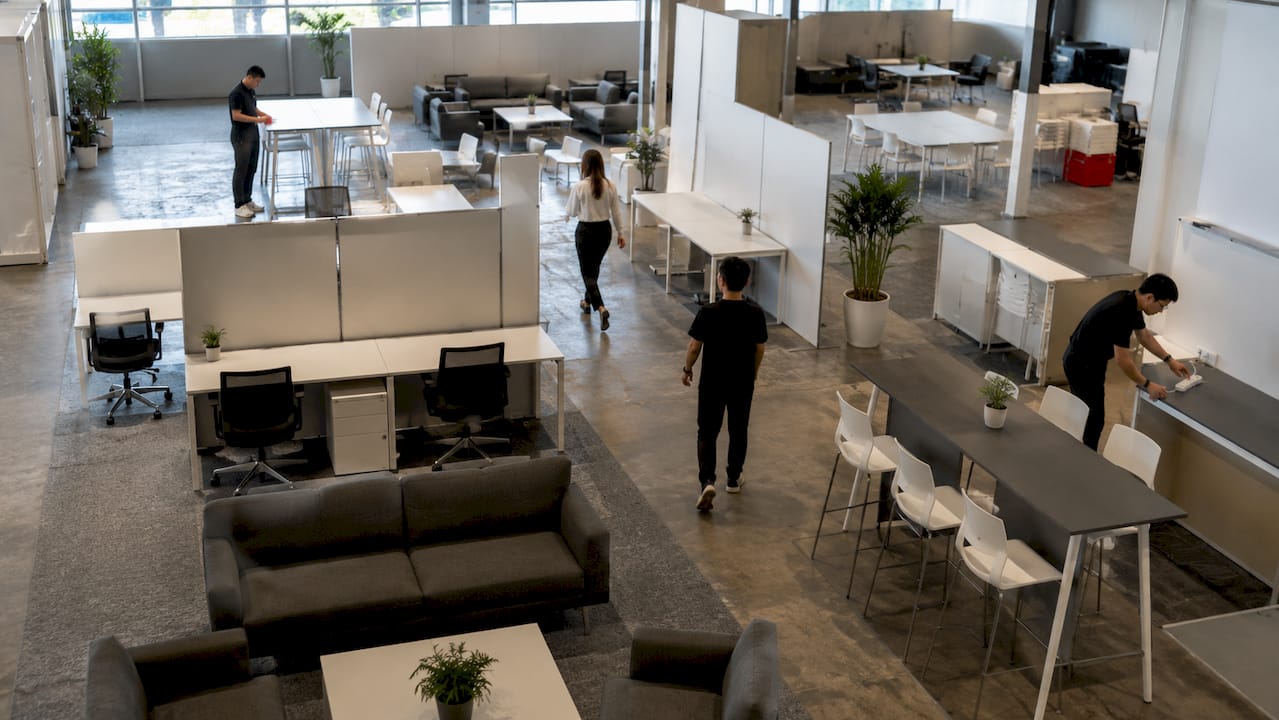 Traffic flow matters more than raw square footage. Mapping traffic flow prevents bottlenecks that slow down operations even when the headcount fits the space. In a typical event office at a Singapore convention centre, the most common bottleneck is the entrance zone, where staff, vendors, and couriers all converge. Separate these flows on your floor plan before you place a single piece of furniture.
The table below shows how space usage changes across common event types in Singapore:
Traffic flow matters more than raw square footage. Mapping traffic flow prevents bottlenecks that slow down operations even when the headcount fits the space. In a typical event office at a Singapore convention centre, the most common bottleneck is the entrance zone, where staff, vendors, and couriers all converge. Separate these flows on your floor plan before you place a single piece of furniture.
The table below shows how space usage changes across common event types in Singapore:
 Power zone planning is a step most planners skip until it is too late. Pre-mapping power outlet zones before furniture arrives prevents extension cord hazards and workflow delays. Decide where your computers, printers, charging stations, and AV equipment will sit, then confirm power points are accessible at those exact locations. Do this before the furniture arrives, not after.
Pro Tip: Ask your venue for a power point map before your site visit. Cross-reference it with your furniture layout so you never discover a mismatch on setup day.
Power zone planning is a step most planners skip until it is too late. Pre-mapping power outlet zones before furniture arrives prevents extension cord hazards and workflow delays. Decide where your computers, printers, charging stations, and AV equipment will sit, then confirm power points are accessible at those exact locations. Do this before the furniture arrives, not after.
Pro Tip: Ask your venue for a power point map before your site visit. Cross-reference it with your furniture layout so you never discover a mismatch on setup day.
 Events Partner supplies modern event furniture for temporary offices and event setups across Singapore, covering corporate conferences, trade shows, roadshows, gala dinners, and product launches. The catalogue includes conference tables, workstation desks, lounge seating, bar tables, counter stools, and branded display pieces, all available on flexible short-term rental periods. Delivery, setup, and collection are coordinated to fit your venue’s access windows. For conference and large-scale setups, Events Partner provides inventory planning support so your office is ready before your team arrives. Contact Events Partner for a quote or visit the website to browse the full catalogue.



 Fleet Deployment Rates
 Payment Methods
 FAQ
FAQ