Last-minute full lorry event furniture delivery in Singapore is one of the fastest ways to watch your budget and composure unravel simultaneously. A single overlooked detail, whether it is a missed loading bay booking or a vehicle that exceeds a venue’s height limit, can cascade into denied access, rushed labour costs, and a setup that starts hours behind schedule. The good news is that most of these problems are entirely preventable. This guide gives you the practical framework to plan ahead, stay compliant with Singapore venue requirements, and keep your event furniture logistics both cost-effective and stress-free.
Table of Contents
Key takeaways
| Point |
Details |
| Book loading bays early |
Singapore venues enforce strict time slots; late booking risks denied vehicle entry on event day. |
| Study venue-specific rules |
Each hall has unique height, weight, and cut-off requirements that must be confirmed before finalising delivery plans. |
| Plan the return trip too |
Post-event teardown logistics are as critical as load-in; overlooking them creates last-minute bottlenecks and extra costs. |
| Flexibility is your cost lever |
Early vendor engagement preserves flexibility, which is the single biggest factor in controlling total delivery spend. |
| Clear roles reduce stress |
Defined responsibilities and real-time communication between all parties dramatically lower on-the-day operational strain. |
Planning prerequisites for full lorry furniture delivery
When we talk about full lorry delivery in the context of event furniture logistics, the industry term most planners use is
freight logistics or
load-in planning. Both refer to the structured process of moving large volumes of furniture from a warehouse to a venue in a single consolidated trip. Understanding the full scope of what that involves, before you confirm anything with a vendor, is where good planning begins.
Singapore exhibition venues require early booking of loading bay time slots, with strict vehicle dimension and unloading duration limits that vary per hall. This is not a soft recommendation. Venues enforce cut-off times, and late freight is routinely denied access. The consequence is not merely inconvenience. It is a scramble to reschedule with a vendor who now has other commitments, at a premium rate.
Here is what you need to secure well before your delivery date:
- Loading bay reservation: Contact the venue operations team as soon as your event date is confirmed. Popular venues in Singapore, particularly those hosting multiple concurrent events, fill slots quickly.
- Vehicle specifications: Hall-specific exhibitor manuals contain the exact height, weight, and length limits for delivery vehicles. A standard lorry that clears one venue may be rejected at another.
- Access passes and permits: Some venues require advance submission of vehicle registration numbers, driver details, and contractor passes. These often have processing lead times of several days.
- Coordination with exhibitor manuals: Request the current manual from the venue or your principal exhibitor contact. Do not rely on a manual from a previous event. Policies change.
- Traffic and security buffers: Build at least 45 to 60 minutes of buffer into your delivery window to account for expressway congestion, especially during morning peak hours near the CBD and Expo areas.
- Documentation: Carry a delivery order, event confirmation letter, and contact numbers for the venue operations supervisor. If access is disputed, you need documentation to resolve it quickly.
Pro Tip: Request the exhibitor manual from the venue the moment your booth or event space is confirmed. Reviewing it on the day before delivery is already too late to act on what you find.
The delivery workflow from booking to teardown
Treating full lorry delivery as a staged operation rather than a single trip is the mental shift that separates planners who have smooth event days from those who spend them fire-fighting. Each stage has its own risks and dependencies.
Here is a practical sequence that works for most Singapore venue deliveries:
- Confirm the delivery window with the venue. Get this in writing, including start time, maximum unloading duration, and the consequence for overrun.
- Brief your furniture vendor on venue-specific requirements. Share the exhibitor manual extracts relevant to vehicle access. Do not assume vendors know the constraints of every venue.
- Schedule delivery during off-peak hours. Early morning slots, typically before 8am, reduce the risk of expressway delays and give your team more staging time before foot traffic builds.
- Assign a dedicated onsite coordinator. This person receives the lorry, guides unloading, and signs off on the delivery order. Having one named individual prevents confusion about who is responsible.
- Execute staged unloading. Furniture should be moved in a deliberate sequence: heavy anchor pieces first, followed by tables, then chairs and accessories. This reduces double-handling and protects items from damage.
- Photograph the delivery on arrival. A timestamped photo record of the furniture condition and placement serves as both a quality check and a dispute reference if damage claims arise later.
- Confirm the return collection schedule in writing. This is where many planners lose time and money. Post-event return logistics require a confirmed loading bay slot, a dismantling crew briefed on packing requirements, and a vehicle booked in advance.
The table below shows how lead times affect your options and costs:
| Planning timeline |
Options available |
Cost impact |
| 4+ weeks ahead |
Full lorry slot, preferred time, optimal vehicle size |
Standard rate |
| 2 to 3 weeks ahead |
Good availability, minor scheduling constraints |
Marginal uplift |
| 1 week ahead |
Limited slots, possible vehicle substitution |
Moderate premium |
| Less than 3 days |
Rush order, restricted inventory, premium labour |
Significant premium |
Pro Tip: Book the return collection slot at the same time you book the delivery. Venues often allocate teardown bays separately, and they fill up just as fast.
Common pitfalls during event furniture delivery
Coordination failures, unclear responsibilities, and poor unloading zone planning are among the most consistent causes of delivery delays and on-the-day team stress. The problems below are not hypothetical. They appear regularly across events of all sizes.
- Compressed timelines creating false urgency: When delivery is booked too late, every subsequent decision is rushed. Rush situations in event production almost always incur additional costs due to expedited timelines, limited inventory, and extra labour. Urgency is expensive.
- Unclear handoff responsibilities: Who signs off on the delivery? Who directs the lorry to the correct bay? Who calls the venue if access is disputed? If these questions are unanswered before the day, expect chaos when the vehicle arrives.
- Ignoring the return trip: Early and explicit scheduling of the return trip and empty vehicle logistics is one of the most overlooked aspects of event furniture planning. Planners who brief teardown crews on the same level of rigour as setup crews consistently avoid the frantic end-of-event scrambles that result in overrun charges.
- Venue rule changes: Venue policies are updated periodically. Relying on knowledge from a previous event at the same location without checking current requirements is a risk that catches experienced planners off guard.
- Late arrivals and venue penalties: Some venues in Singapore impose financial penalties for overrunning the allocated loading bay time. Missing your slot entirely can mean waiting hours for the next available window, which directly affects setup completion.
“The primary source of stress in event delivery is not distance but coordination and unclear communication during handoffs.” — Event logistics complete guide
For contingency planning, it helps to maintain a short list of
furniture rental vendors who have a track record with fast turnarounds. Even with the best planning, the occasional venue restriction or traffic incident requires a supplier who can adapt quickly and suggest practical alternatives without escalating your cost significantly.
What early planning actually saves you
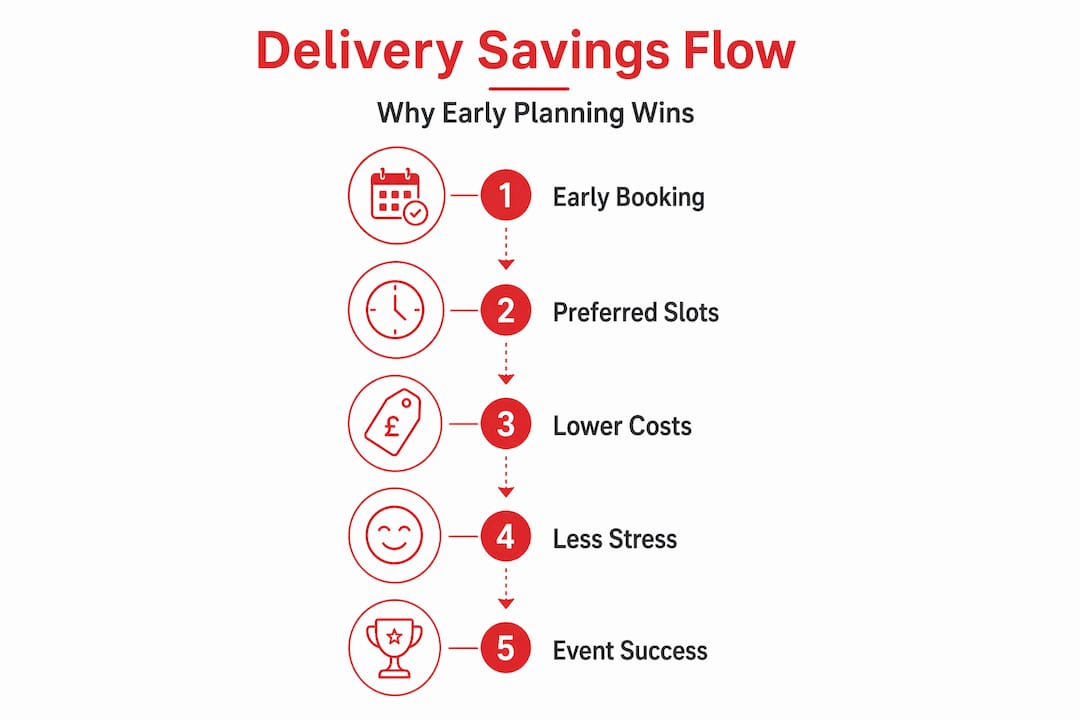
The financial case for planning ahead is more concrete than most planners realise. Flexibility is identified as the key cost-saving factor in event logistics. When you give yourself and your vendors adequate lead time, you preserve that flexibility at every decision point.
Consider the cumulative savings available to a planner who confirms their
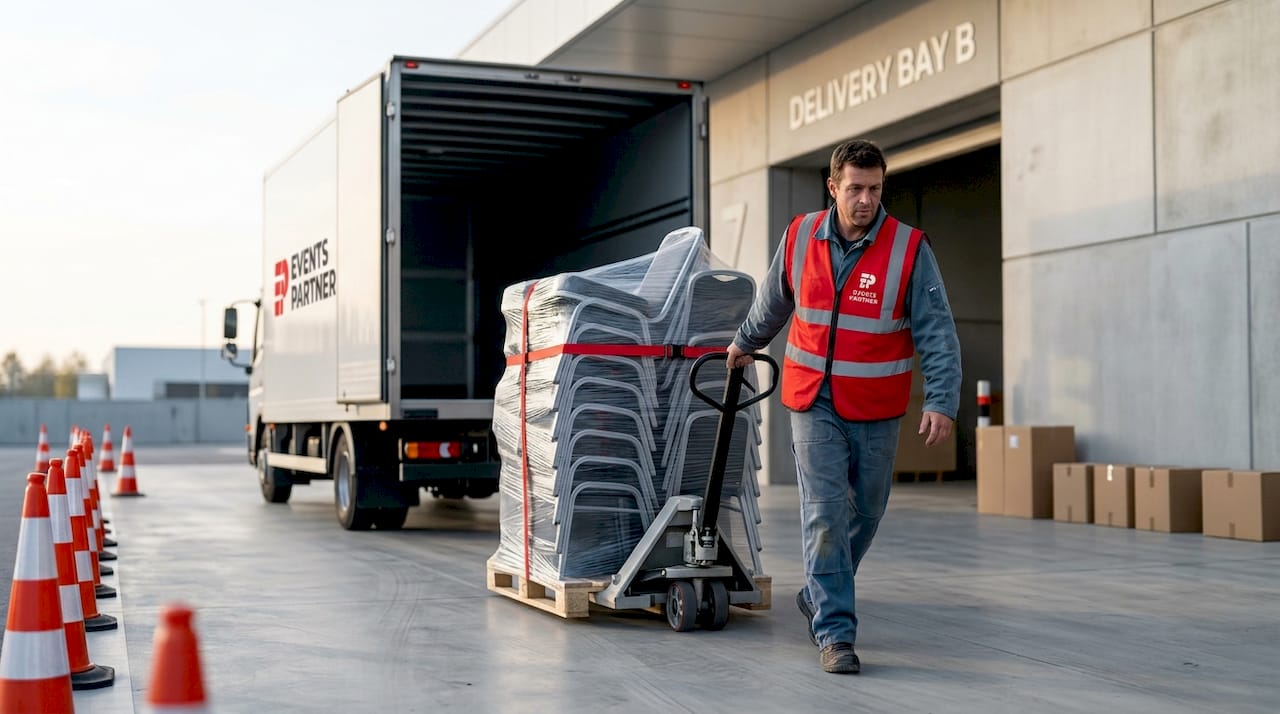
full lorry delivery requirements four or more weeks in advance. Standard delivery rates apply rather than rush premiums. The vendor has time to stage inventory, confirm vehicle availability, and assign an experienced crew. The venue loading bay slot is secured at a preferred time. There is no need to pay premium labour rates for weekend or after-hours setup caused by a delayed delivery window.
Contrast that with a last-minute booking. Beyond the direct cost increases, there is the less visible cost of management time spent resolving problems under pressure, the reputational risk of a poorly set-up event, and the toll on your team’s morale when they spend event day in crisis mode rather than managing the programme.
A systematic communication plan defining roles and escalation paths reduces errors and stress during event furniture delivery. This is as much a financial tool as an operational one. Fewer errors mean fewer rectification costs. Less stress means a team that performs at its best when the doors open.
For events with
multiple furniture zones or simultaneous delivery windows across different halls, the compounding value of advance planning is even more pronounced. Each additional variable you have not pre-confirmed is a potential delay multiplier.
My honest view on delivery planning in Singapore
From the team at Events Partner:
I’ve seen planners with meticulous décor schemes and immaculate event programmes come undone because they left delivery logistics as an afterthought. In Singapore, this is a particularly unforgiving mistake. The venues here operate on tight schedules, sometimes with three different events loading in simultaneously across adjacent halls. There is no room for vehicles circling because no bay was pre-booked, or for crews waiting because access passes were not submitted in advance.
What I’ve learned from working across hundreds of events is that the planners who have the calmest event days are not the ones with the smallest events. They are the ones who treated delivery logistics with the same seriousness as the event programme itself. They confirmed the exhibitor manual, booked their slots early, and briefed every party in the chain at least a week out.
The return trip lesson took longer for me to internalise. I used to focus all my energy on the setup and treat teardown as something to figure out later. That was a mistake that showed up as overrun charges, stressed crews, and frantic calls to venues at 11pm. Now, the return collection slot is booked on the same day as the delivery. Full stop.
Flexibility is the most underrated cost saver in this industry. You cannot buy it back once the calendar gets close. The planners who protect it by deciding early are the ones who stay on budget and still have energy left to run a great event.
— Events Partner
How Events Partner supports stress-free delivery planning
Events Partner works with corporate event teams, exhibition organisers, wedding planners, and agencies across Singapore to take the operational complexity out of event furniture logistics. The inventory covers everything from conference chairs and cocktail tables to lounge sets and exhibition counters, all maintained in ready-to-deliver condition.
What makes the difference is the planning support that comes with the furniture. Events Partner’s team is familiar with the access requirements, loading bay constraints, and exhibitor manual specifics for major Singapore venues. When you book early, the team can confirm vehicle sizing, schedule your delivery and return collection windows together, and flag any compliance requirements specific to your venue before they become a problem on the day.
Whether you are planning a
corporate event for 500 guests or a focused product launch with a tight setup window,
event furniture rental through Events Partner is structured to reduce your planning burden, not add to it. Get in touch early, share your venue details, and let the logistics side of your event be one fewer thing to worry about.
FAQ
What is a full lorry delivery in event furniture logistics?
A full lorry delivery refers to a single consolidated freight trip that carries the complete furniture order for an event in one vehicle. It is the standard approach for large-scale events where individual smaller deliveries would be inefficient or exceed venue loading bay time limits.
How early should I book a loading bay slot in Singapore?
Book as soon as your event date and venue are confirmed, ideally four or more weeks in advance. Singapore venues enforce strict cut-off times and late freight may be denied access, so early booking is non-negotiable for major exhibition and convention venues.
Why does last-minute event furniture delivery cost more?
Late bookings reduce vendor flexibility, which is the main lever for cost control in event logistics. Rush orders incur premiums for expedited scheduling, limited inventory availability, and after-hours or weekend labour rates.
What documents should I carry on delivery day?
Carry a delivery order, the event confirmation letter, vehicle registration details, and contact numbers for the venue operations supervisor. Some venues also require contractor passes and driver identification submitted in advance.
Do I need to plan the furniture return collection separately?
Yes. Post-event return logistics require their own loading bay booking, a briefed dismantling crew, and a confirmed vehicle schedule. Book the return slot at the same time as your delivery to avoid overrun charges and last-minute scrambles during teardown.
Recommended






 Fleet Deployment Rates
 Payment Methods
 FAQ
FAQ