

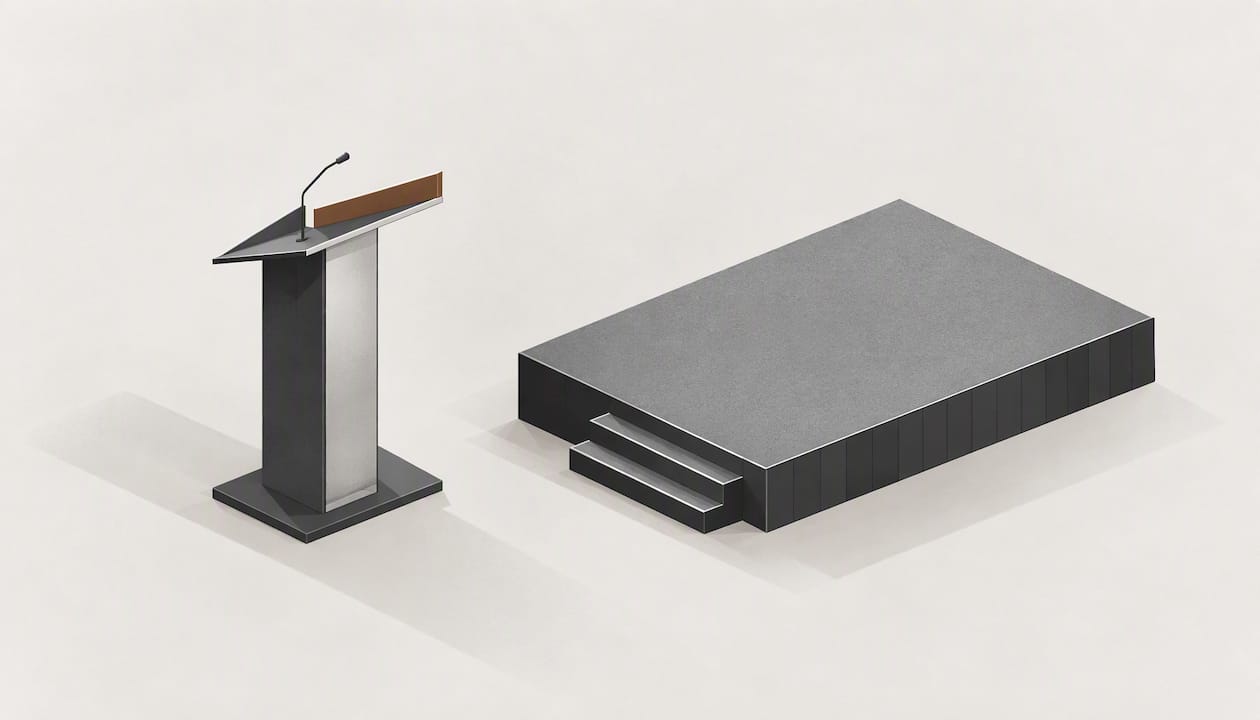
A lectern is a stand to read from; a podium is a platform to stand on. The two words overlap in everyday speech, especially in North American English, so you will often hear “podium” used for the stand. For events, the safest move is to say exactly what you need rather than rely on one word.
TL;DR:
- A lectern’s slanted top holds notes or a microphone; podiums and rostra raise speakers for visibility, while a dais serves as a low stage.
- A lectern can sit on the floor or on a raised platform, combining a reading surface with extra height for large rooms and ceremonies.
- Because North American speakers often use podium for a lectern, event planners should specify whether they need a reading stand or raised platform.
- Venue requests should state whether the lectern is floor standing or table top, the microphone setup, cable route, height, branding, and accessibility needs.
A lectern is a stand with a slanted top that holds books, notes or a microphone, meant for a speaker to stand behind. The word comes from the Latin legere, “to read”, and dictionaries date it to the 14th century. Its job has stayed the same ever since: support the thing you read from.
A podium is a raised platform or plinth that a person stands on. The point is height: it lifts the speaker so the room can see them. A rostrum works the same way, and its origin is vivid: the Latin word for a ship’s “beak” or ram, which decorated the speaking platforms of the Roman Forum. You stand on a rostrum, not behind it.
A dais or pulpit may be used in some event or worship settings; describe the form and function you need when making a request.
Dictionaries date the word “lectern” to the 14th century; it refers to a reading stand with a slanted top. The confusion sits almost entirely on the “podium” side.
Lecterns appear wherever someone reads or presents from prepared material. Think lectures, conference keynotes, panel openings, readings in places of worship and corporate announcements. The features that matter are a slanted top that keeps notes from sliding, a ledge or lip so papers stay put, and a microphone clip or built-in mic.
Podiums and rostra show up where visibility is the point. Award ceremonies lift the presenter so the whole room can see who is handing over the trophy. Music conductors stand on a small platform so the orchestra can follow every gesture. Parades, graduations and formal speeches use the same logic.
You can also combine them. A lectern can sit on a podium or straight on the floor, which is exactly how many ceremonies are set up: the platform gives height, the lectern gives a place for the script.
Examples a planner will recognise:
Our guide to rostrum types for VIP speakers covers the checks worth making before you book, and our notes on conference layouts, AV and reset show how the speaker position fits the wider room.
Mostly because everyday English drifted. In North American English, “podium” has effectively become a synonym for “lectern”, and many authorities accept that usage, so calling it “incorrect” is more pedantry than error. In British English you are more likely to hear “lectern” for the stand and keep “podium” or “rostrum” for the platform. Dictionaries also list “rostrum” and “podium” as overlapping words for small raised platforms, which adds to the blur.
AV and event professionals know this. In practice they often use the words interchangeably, which is why a request that says only “podium” can produce a platform when you wanted a stand, or the reverse. The fix is simple: describe the item by what it does and how big it is, not by one word.
Pro Tip: Ask for “a floor-standing unit with a slanted top and a microphone clip” or “a raised platform of the required height” instead of just “a podium”.

A precise request saves a day of emails and a last-minute scramble. Work through this checklist before you send a specification:
A ready-to-copy phrase: “One floor-standing lectern with a slanted top, microphone clip and a clear front panel for branding, placed on a raised platform.” It leaves no room for guessing.
Accessibility deserves its own line. Check that a wheelchair user can reach the speaking position, that a shorter speaker can see over the top, and that a platform edge is clearly marked and stable.
Pro Tip: Send a simple sketch or a photo of the stage with your request. One image removes more doubt than three paragraphs of description.
We supply rostra and conference furniture for corporate events, launches, awards nights and exhibitions. Delivery, setup and collection arrangements depend on the order. If you want to browse first, our conference furniture rental page shows what suits a meeting or conference room, and our Partner™ platform lets you explore items and request a quotation without a long back and forth.

Send us your checklist from above, including the height, microphone and branding details, and we will match it to the right item. You can start from our event furniture rental range or view the delivery and setup fees to plan your budget. When you are ready, request a quotation through Partner™ with your exact specifications.
A table top lectern is a small, slanted reading stand that sits on a table rather than standing on the floor. It suits small meetings, training sessions and head tables where a full-height unit would be too large. It still holds notes, a book or a microphone at a comfortable reading angle.
A lectern is a stand with a slanted top that supports a speaker’s notes, book or microphone while they speak. The word comes from the Latin for “to read”. You stand behind it, rather than on it.
Not exactly. A podium is a small raised platform for one person, while a stage is a larger raised area for many people or a performance. In practice a podium can be a mini stage for a single speaker or conductor.
In a church, a lectern may be used as a reading stand. Ask the venue what type of stand it uses and what the speaker needs.



 Delivery Fees
 Payment Methods
 FAQ