Roadshow furniture rental Singapore: tables, chairs, and display guide
June 26, 2026
Roadshow furniture rental in Singapore is the practice of hiring tables, chairs, and display structures for short-term brand activations, product launches, and promotional events held in malls, MRT concourses, and public venues. Unlike permanent exhibition builds, roadshow setups must be portable, self-supporting, and compliant with strict venue rules. The right combination of event furniture rental and display hardware determines how professional your booth looks, how smoothly visitors flow through it, and whether your team can pack down and move on without a logistics headache.
What are the standard tables, chairs, and display setups for Singapore roadshows?
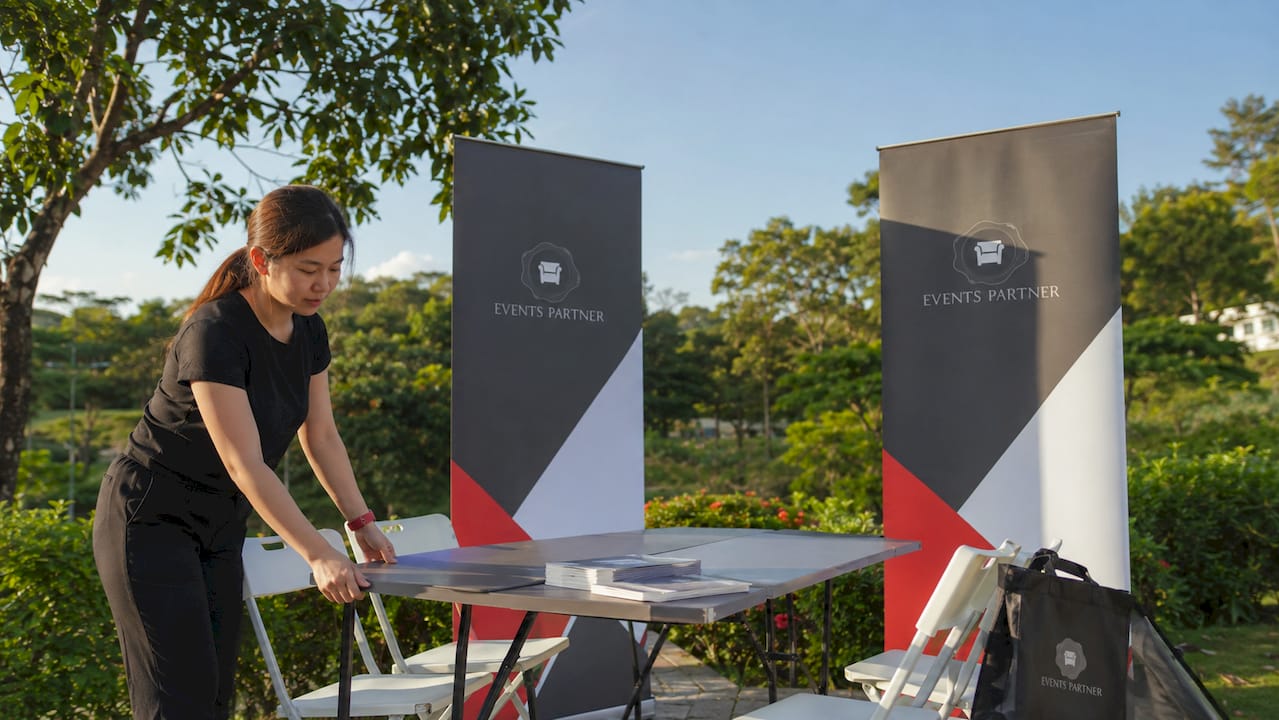
Standard roadshow setups in Singapore malls use two 85cm x 200cm pull-up banners flanking a central table or counter for optimal brand visibility and visitor flow. That configuration works because it frames the booth clearly, signals the brand from a distance, and leaves the table free for product demos or sign-up forms.
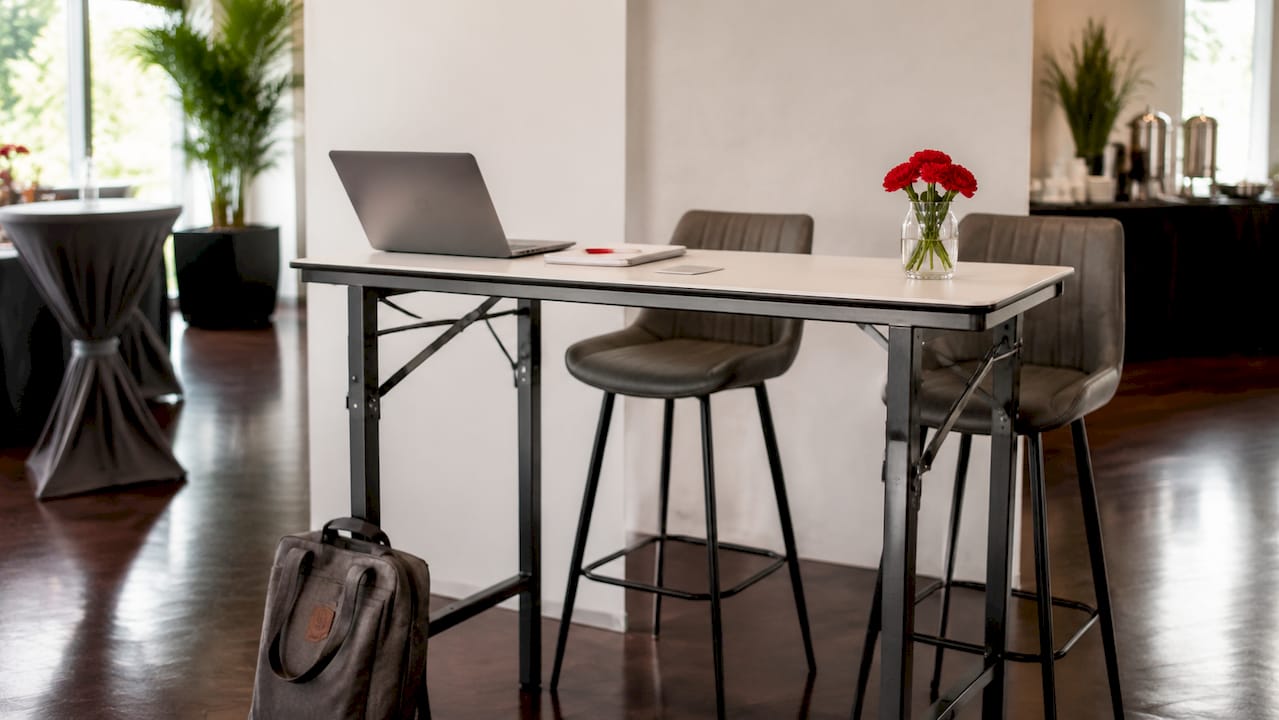
The table itself is typically a folding or modular counter at standing height, around 75–90cm tall, so staff can engage visitors without sitting down. Chairs are usually bar stools or folding chairs placed behind the counter for staff rest periods, not for visitor seating. Visitor-facing seating is rare in mall roadshows because dwell time is short and space is limited.
Furniture type
Typical size
Common use
Pull-up banner
85cm x 200cm
Brand backdrop and side panels
Folding counter
90cm x 60cm x 75cm
Product display and sign-ups
Bar stool
Seat height 65–75cm
Staff seating behind counter
Modular backdrop
2m x 2m or 3m x 2.5m
Full-width brand wall
Easel with signage
A1 or A0 size
Directional or promotional messaging
Display structures fall into three categories: pull-up banners for portability, pop-up backdrops for larger visual impact, and lightbox frames for venues with high visual competition. Each serves a different budget and frequency of use.
Pull-up banners are the most portable option. Premium banners weigh under 6kg combined, making solo transport by taxi or MRT entirely practical.
Pop-up backdrops create a larger branded wall but require more assembly time and a vehicle for transport.
Lightbox frames use LED-lit panels that draw attention in bright mall environments where standard print banners can look flat.
Pro Tip:Order a matte-laminated graphic for your pull-up banners rather than gloss. Matte lamination reduces glare under mall LED lighting and keeps your brand message readable from across the aisle.
How to plan furniture rental logistics for Singapore roadshows efficiently
Furniture rental logistics for Singapore roadshows require planning around three variables: lead time, transport method, and on-site access windows. Getting any one of these wrong adds cost and stress on event day.
Book early for custom setups, fast for standard furniture. Custom exhibition builds need 4–6 weeks for design and venue approvals. Standard furniture-only rentals, such as tables, chairs, and pull-up banners, can often be delivered within 48 hours in Singapore. Know which category your roadshow falls into before you start calling suppliers.
Plan transport by furniture weight and size. Two premium pull-up banners weigh under 6kg combined. A folding counter and two bar stools will need a van or a Grab van booking. Measure your furniture against the lift dimensions of your venue before delivery day, particularly for basement loading bays at Orchard Road malls.
Confirm your access window with the mall management office. Most Singapore malls restrict deliveries to early morning slots, typically before 10am, and require a separate goods lift booking. Missing this window means your team is hand-carrying furniture through public entrances during peak hours.
Coordinate AV and furniture together. Separating AV and furniture vendors often results in setup incompatibilities, particularly around cable routing and power access. A single point of contact for the full setup prevents these conflicts before they happen on-site.
Build in a 30-minute buffer before the event opens. Roadshow setups in malls are rarely straightforward. Security checks, trolley availability, and lift queues all add time. A buffer protects your opening.
Pro Tip:Ask your furniture rental supplier for a packing list with dimensions and weights for every item. Share it with your transport provider in advance. This one step prevents the most common roadshow day delays.
What are key venue compliance rules for furniture and displays in Singapore malls?
Singapore venue compliance for roadshow furniture is non-negotiable. Early consultation with mall management prevents costly on-site changes that can delay your opening or result in a forced teardown.
The core rules that apply across most Singapore malls are consistent, even if specific limits vary by property manager.
Height limits apply to all display structures. Most malls set a maximum of 2.5–3 metres for freestanding displays. Anything taller requires a structural engineer’s endorsement and advance approval.
All structures must be fully self-supporting. Singapore venue rules require display structures to stand independently with no attachment to walls, columns, floors, or ceilings. Pull-up banner bases are weighted for exactly this reason.
No drilling, taping, or fixing to surfaces. Adhesive hooks, cable ties around columns, and floor tape that leaves residue are all prohibited. Use weighted bases and freestanding frames throughout.
Power access is limited. The standard exhibitor package in Singapore malls typically includes one power socket. Plan your AV and lighting around that constraint or arrange additional power with the venue in advance.
Risk assessments and technical drawings may be required. For larger setups or those involving screens and AV equipment, mall management often requests documentation before approving your booth plan.
Pro Tip:Submit your booth layout drawing to the mall management office at least two weeks before your event date. Include dimensions, materials, and power requirements. This single document resolves most compliance queries before they become problems.
How to choose the best display setups for impact and portability
The right display setup for a Singapore roadshow depends on three factors: how often you run events, how far you travel between venues, and how competitive the visual environment is at your target location.
Display type
Portability
Visual impact
Best for
Pull-up banner
High
Moderate
Single-day or frequent roadshows
Pop-up backdrop
Medium
High
Multi-day activations with vehicle transport
Lightbox frame
Low
Very high
High-traffic malls with strong visual competition
Modular aluminium frame
Low
Very high
Teams running 4+ events per year
Lightbox signage attracts more attention than non-lit displays in indoor venues with high visual competition. This matters at locations like Suntec City, VivoCity, or Ion Orchard, where dozens of brands compete for the same shopper attention.
The rent-versus-buy decision is straightforward. Purchasing modular display hardware costs S$1,890 to S$2,600 and becomes cost-effective only for teams attending four or more events per year. For single or infrequent roadshows, rental is the financially sensible choice. It also removes the burden of storage, maintenance, and graphic updates between events.
Choose pull-up banners when your team travels by public transport or taxi and needs to set up without assistance.
Choose a pop-up backdrop when you need a full-width branded wall and have vehicle transport arranged.
Choose lightbox displays when your venue has strong ambient lighting and standard print banners look washed out.
Rent rather than buy unless your event calendar justifies the capital outlay and storage costs.
Portable display stands are ideal for teams moving frequently between venues. They offer brand consistency without the logistical overhead of owned hardware.
Pro Tip:If you are running a roadshow series across three or more Singapore malls in the same month, ask your rental supplier about a weekly rate. It is almost always cheaper than booking individual daily rentals for each location.
What practical tips improve visitor interaction and brand visibility at roadshow booths?
Booth layout and furniture placement directly affect how many visitors stop, engage, and convert. A well-placed banner and a correctly sized table do more for brand visibility than expensive graphics on a poorly positioned stand.
Position pull-up banners at the outer edges of your booth footprint. Banners placed at the sides frame the space and draw the eye inward toward your staff and product. Banners placed behind the counter are often obscured by the team standing in front of them.
Use a table sized for your activity. A full 180cm table for a two-person sign-up station wastes space and creates a physical barrier between staff and visitors. A 90cm counter is usually sufficient and keeps the interaction personal.
Design your counter with cable access in mind. Counters and backdrops designed with accessible cable routing avoid damage and downtime during live events. If your counter houses a screen or tablet, confirm that power cables can be routed cleanly before the event opens.
Stabilise banners in high-traffic aisles. Extend base feet fully and use carrying bags as ballast in crowded areas. A toppled banner mid-event is a safety issue and a brand embarrassment.
Keep the counter surface clear. Brochures, products, and devices should be organised, not stacked. A cluttered counter signals disorganisation and discourages visitors from approaching.
For planners managing large-scale exhibition furniture across multiple zones, the same principles apply at a larger scale. Sight lines, traffic flow, and access to equipment all determine whether a setup works in practice.
Key takeaways
Effective roadshow furniture rental in Singapore requires matching table and chair types to your venue footprint, selecting displays by portability and visual impact, and confirming compliance requirements before delivery day.
Point
Details
Standard setup configuration
Two 85cm x 200cm pull-up banners flanking a central counter is the proven Singapore roadshow layout.
Rental lead times vary
Standard furniture rentals can be delivered within 48 hours; custom builds need 4–6 weeks.
Venue compliance is mandatory
All structures must be self-supporting; confirm height limits and power access with mall management early.
Rent versus buy threshold
Renting is cost-effective for fewer than four events per year; modular hardware purchase suits frequent exhibitors.
Matte lamination matters
Matte-finish banner graphics reduce glare under mall LED lighting and improve readability.
What I have learned from planning Singapore roadshows
The most common mistake I see event planners make is treating furniture and AV as two separate workstreams. They book the banners, the counter, and the chairs from one supplier, then arrange screens and sound from another, and discover on setup morning that the cable routing does not work and the counter blocks the power socket. Integrated planning, where furniture and AV are coordinated together from the start, removes this problem entirely.
The second mistake is underestimating venue compliance. Singapore mall management teams are thorough. They will ask for drawings, material specifications, and risk assessments. Planners who treat this as a formality and submit incomplete documentation end up making last-minute changes on-site, which costs time, money, and goodwill with the venue.
My honest view is that the best roadshow setups are the ones that look effortless. That effortlessness comes from decisions made weeks before the event: the right table size, the right banner finish, the right transport booking, and the right conversation with the mall office. The furniture itself is rarely the problem. The planning around it almost always is.
For planners who run roadshows regularly, I would also encourage a serious look at selecting the right event furniture for each specific venue rather than defaulting to the same setup every time. A configuration that works at a suburban community mall will feel undersized at a flagship Orchard Road location.
— Events Partner
Planning your next roadshow? Events Partner can help
Events Partner provides roadshow furniture rental tailored for Singapore mall activations, MRT concourse events, and brand roadshows across the island. The catalogue includes folding counters, bar stools, modular tables, and display furniture sized for standard mall footprints.
Delivery and collection are handled directly, with scheduling built around your venue access windows. The team supports compliance planning, including booth layout advice and documentation guidance for mall submissions. For planners managing multiple roadshow dates, Events Partner offers flexible rental periods and repeat-booking support. Enquire through the event furniture rental page to get a quote for your next activation.
FAQ
What furniture do I need for a Singapore mall roadshow?
The standard setup is a folding counter or modular table, two pull-up banners, and one or two bar stools for staff. Most Singapore mall footprints accommodate a 2m x 2m to 3m x 3m booth configuration.
How far in advance should I book roadshow furniture rental in Singapore?
Standard furniture rentals can be arranged within 48 hours, but booking at least one week ahead is recommended. Custom display builds or large multi-piece setups require 4–6 weeks lead time for design and venue approvals.
Are pull-up banners allowed in all Singapore malls?
Pull-up banners are permitted in most Singapore malls because they are self-supporting and leave no marks on surfaces. Confirm height limits and base requirements with the specific mall management office before your event date.
Is it cheaper to rent or buy display hardware for roadshows?
Renting is more cost-effective for teams running fewer than four events per year. Purchasing modular aluminium display hardware, which costs S$1,890 to S$2,600, becomes financially sensible only for frequent exhibitors with storage space available.
What are the most common venue compliance issues for Singapore roadshows?
The most frequent issues are structures exceeding the 2.5–3 metre height limit, displays attached to walls or columns, and insufficient power planning. Submit a booth layout drawing to mall management at least two weeks before your event to resolve these in advance.


 The right display setup for a Singapore roadshow depends on three factors: how often you run events, how far you travel between venues, and how competitive the visual environment is at your target location.
 Delivery and collection are handled directly, with scheduling built around your venue access windows. The team supports compliance planning, including booth layout advice and documentation guidance for mall submissions. For planners managing multiple roadshow dates, Events Partner offers flexible rental periods and repeat-booking support. Enquire through the event furniture rental page to get a quote for your next activation.



 Delivery Fees
 Payment Methods
 FAQ
FAQ