


Venue constraints are the physical, structural, and regulatory limitations of an event space that directly determine how you plan your layout, select your furniture, and manage guest flow. Every Singapore event planner encounters them, whether you are working in a Suntec City exhibition hall, a hotel ballroom at Marina Bay Sands, or a mall atrium in Orchard Road. The right event furniture does not just fill a room. It solves problems. Choosing furniture by event phase, scale, and function is the single most practical tool you have for overcoming venue challenges before they affect your guests.
Venue constraints fall into four categories: physical space, fixed infrastructure, safety and regulatory requirements, and logistics access. Understanding each one before you commit to a furniture order separates events that run smoothly from those that do not.
Physical space is the most obvious constraint. Space per person varies significantly by setup: standing receptions require roughly 9.5 to 10 square feet per person, banquet rounds need 12 to 14 square feet, and theatre-style seating uses about 9 square feet per person. Production staging and AV equipment add a further 20 to 30 square metres to your usable space calculation. That means a 500-square-metre ballroom does not seat 500 people at a gala dinner. It seats considerably fewer once you account for the stage, buffet stations, and service corridors.
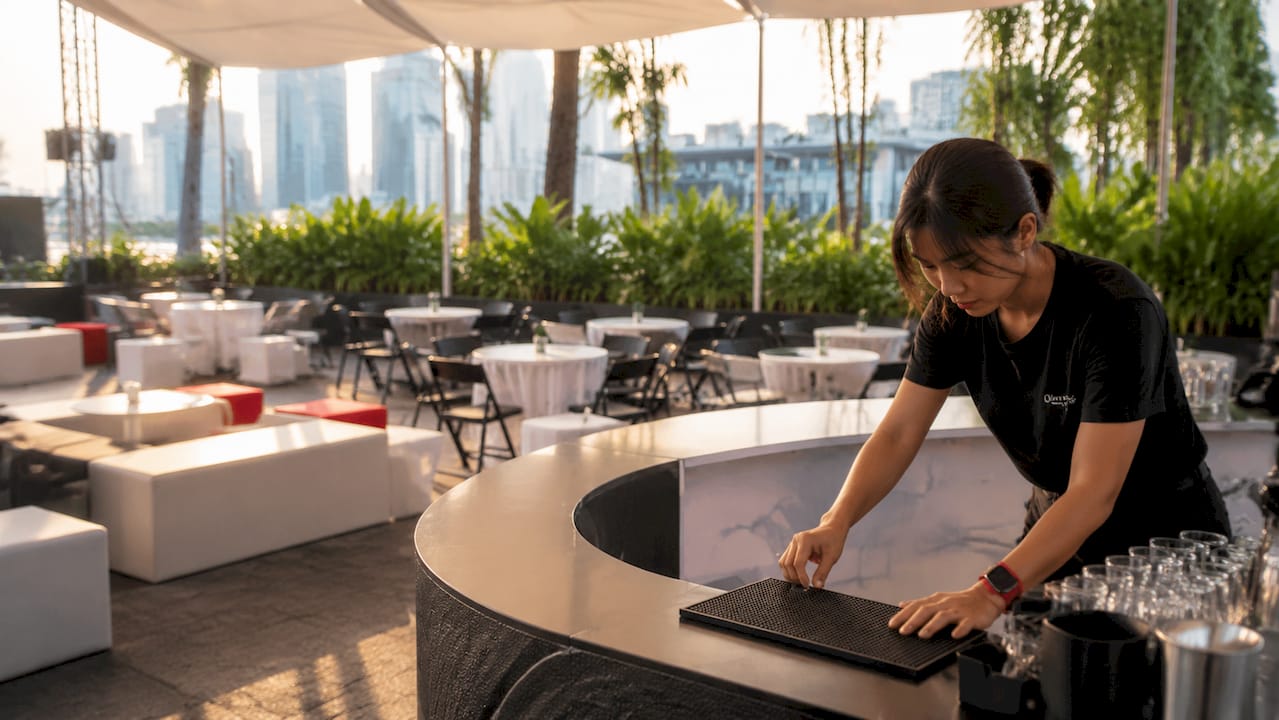
Fixed infrastructure includes pillars, embedded utilities, fire hose reels, and permanent stages. These cannot be moved, and furniture placement must work around them. In Singapore hotel ballrooms, pillars are a near-universal feature. Placing round tables around pillars rather than rectangular ones reduces dead zones and keeps sightlines cleaner for all guests.
Safety and regulatory requirements are non-negotiable. Pathways must be at least 0.9 metres wide for accessibility compliance, and aisles between banquet tables should be 1.8 metres to maintain safe flow and avoid a venue shutdown. Singapore’s fire safety regulations also mandate clear egress routes at all times, which directly affects where you can position lounge furniture, cocktail tables, and display units.
Logistics access is the constraint most planners underestimate. Venue capacity figures from sales teams represent theoretical maximums. Subtract fixed infrastructure and service zones and you can lose 30 to 40 per cent of usable space. Furniture must also physically fit through service lifts and loading bays, which rules out oversized pieces in many older Singapore venues.
Pro Tip: Always request the venue’s technical specifications sheet, not just the capacity chart. Ask specifically for lift dimensions, loading bay access hours, and any no-fix policies before placing your furniture order.
Singapore’s event venues range from purpose-built convention centres like Suntec Singapore and Marina Bay Sands Expo to boutique hotel ballrooms, mall atriums, and rooftop spaces. Each presents a distinct set of event space limitations.
Venues rated for higher capacity feel empty and lose atmosphere at low guest counts. Intimate rooms better suit 100 to 400 guests to sustain energy. This means that choosing a venue slightly smaller than your maximum guest count, and then using furniture to define zones and create density, often produces a better guest experience than filling a large hall at 60 per cent capacity.
Pro Tip: When planning a multi-zone event, assign a furniture type to each zone before you assign a layout. Reception zones suit cocktail tables and lounge seating. Dining zones need round or rectangular tables with chairs. Presentation zones require theatre or classroom seating. Mixing zone furniture types without a clear boundary creates confusion for guests.
Furniture is infrastructure, not just decor. Choosing it by event phase enhances transitions and guest experience in ways that no amount of floral arrangement or lighting can replicate. Here is how specific furniture choices address specific constraints.
Modular furniture reduces footprint and increases flexibility. Modular sofas, configurable lounge units, and nesting tables can be arranged to fit irregular floor plans around pillars and fixed structures. They also allow you to reconfigure the space between event phases, such as moving from a cocktail reception to a seated dinner, without a full furniture changeover.
Round tables maximise usable space in pillar-heavy rooms. A 1.5-metre round table seats eight guests and creates natural conversation clusters. Rectangular tables seat more people per linear metre but require wider aisles and create longer sightline obstructions in rooms with pillars.
Stackable and lightweight chairs support tight logistics. In venues with small service lifts or limited staging areas, stackable chairs reduce the number of trips required and allow faster setup and teardown. This is particularly relevant for one-day corporate events at Singapore convention centres where turnaround times between events are short.
Freestanding structures respect no-fix policies. Freestanding bar counters, display units, and registration desks require no drilling or fixing. They can be positioned and repositioned without venue approval and removed cleanly at the end of the event.
Appropriately scaled lounge seating supports circulation paths. Low-profile lounge seating placed along the perimeter of a space keeps central circulation paths clear. This is the correct approach for networking events and VIP lounges in Singapore hotel venues, where guest flow between zones is continuous throughout the evening.
Modular and multi-use furniture reduces on-site labour costs and increases versatility. For Singapore planners managing tight budgets and tighter timelines, this is a practical advantage, not a stylistic preference. You can find a detailed breakdown of lounge furniture options suited to different venue types in Events Partner’s Singapore planner’s guide.
Effective layout design in constrained venues starts with a scaled floor plan. Exceeding venue occupancy limits violates Singapore law and risks event cancellation. Digital scale drawings reduce costly mistakes that come from estimating by eye.
The table below summarises recommended spacing standards for common Singapore event setups.

| Setup type | Space per person | Minimum aisle width | Notes |
|---|---|---|---|
| Standing reception | 9.5 to 10 sq ft | 0.9 m | Subtract cocktail table footprint |
| Banquet rounds | 12 to 14 sq ft | 1.8 m | Add 20 to 30 sq m for staging |
| Theatre style | 9 sq ft | 1.2 m | Egress aisles must remain clear |
| Classroom style | 14 to 16 sq ft | 1.2 m | Include space for tables |
| Cocktail lounge | 8 to 10 sq ft | 0.9 m | Service paths need 1.8 m |
Service infrastructure like buffet stations and staff paths must be subtracted from guest capacity calculations to avoid overcrowding. This is the step most planners skip, and it is the most common cause of a venue feeling cramped on the night.
Practical layout considerations for constrained Singapore venues include the following.
Pro Tip: Keep a 10 to 15 per cent chair buffer in your rental order. Last-minute guest additions are common at Singapore corporate events and gala dinners, and having spare chairs on-site is far less disruptive than an emergency delivery.
Choosing the right furniture rental for a constrained venue requires matching three things: the furniture’s physical dimensions to the venue’s access points, the furniture’s function to the event’s programme, and the furniture’s style to the event’s brand.
For hotel-based events specifically, Events Partner’s hotel event furniture catalogue covers ballroom setups, pre-function area lounge arrangements, and VIP room configurations suited to Singapore’s major hotel venues.
Venue constraints are fixed realities that furniture choices can directly address, and the most effective approach combines scaled planning, modular furniture selection, and logistics coordination before the event day.
| Point | Details |
|---|---|
| Space calculations are non-negotiable | Subtract fixed infrastructure and service zones from total capacity before planning seating. |
| Furniture type determines usable space | Round tables, stackable chairs, and modular lounge units reduce footprint in constrained venues. |
| Safety compliance shapes layout | Aisles must be at least 1.8 m for banquet setups; egress routes must remain clear at all times. |
| Scaled floor plans prevent costly errors | Digital drawings catch access and capacity problems before furniture is delivered. |
| Logistics access affects furniture choice | Measure lifts and doorways before ordering large or long furniture pieces for Singapore venues. |
The most common mistake I see is planners treating venue capacity as a starting point rather than a ceiling. A hotel ballroom rated for 300 banquet guests will comfortably seat 220 once you account for the stage, the buffet run, the service corridor, and the AV desk. Planners who ignore this end up with a room that feels overcrowded and a service team that cannot move efficiently. The guest experience suffers, and the client notices.
The second mistake is leaving furniture decisions until after the layout is finalised. Furniture is not a finishing touch. It is the layout. The size of your tables determines your aisle widths. The height of your cocktail tables determines the energy of your reception zone. The depth of your lounge seating determines how much floor space you lose along the perimeter. Every furniture decision is a spatial decision, and it needs to be made at the same time as the floor plan, not after it.
What actually works in Singapore venues is a combination of modular furniture, a realistic capacity calculation, and a rental partner who understands logistics. Planners who avoid common furniture planning mistakes consistently produce better events, not because they have bigger budgets, but because they plan the infrastructure before they plan the aesthetics. The furniture holds the event together. Everything else sits on top of it.
— Events Partner
Events Partner supplies modern event furniture rental across Singapore for corporate events, conferences, exhibitions, gala dinners, product launches, and weddings. The catalogue includes modular lounge seating, round and rectangular banquet tables, stackable chairs, cocktail tables, bar counters, and freestanding display units, all suited to Singapore’s diverse venue types. Every rental includes logistics coordination, on-time delivery, and professional setup support. For corporate event furniture and conference setups, Events Partner’s team can advise on layout options that work within your venue’s specific constraints. Request a quote and get transparent pricing with no hidden fees.
Standing receptions require 9.5 to 10 square feet per person, banquet rounds need 12 to 14 square feet, and theatre-style seating uses approximately 9 square feet per person. Always subtract fixed infrastructure and service zones from the total floor area before calculating guest capacity.
Freestanding bar counters, modular lounge units, stackable chairs, and self-supporting display units are the correct choices for venues that prohibit drilling or fixing to walls and floors. These items can be repositioned without venue approval and removed cleanly after the event.
Assign a furniture type to each zone before drawing your layout. Reception zones suit cocktail tables and lounge seating, dining zones require round or rectangular tables with chairs, and presentation zones need theatre or classroom seating. Use furniture placement to define zone boundaries rather than relying on signage alone.
Venue capacity figures represent theoretical maximums. Subtracting fixed infrastructure, service zones, staging, and AV equipment typically reduces usable capacity by 30 to 40 per cent. Always work from a scaled floor plan that marks all fixed elements before confirming your guest count and furniture order.
Confirm your furniture rental at least three to four weeks before the event date for standard corporate and conference setups. For large-scale exhibitions or multi-zone gala dinners at venues like Suntec Singapore or Marina Bay Sands, six to eight weeks is advisable to secure inventory and coordinate delivery access windows.



 Fleet Deployment Rates
 Payment Methods
 FAQ
FAQ