

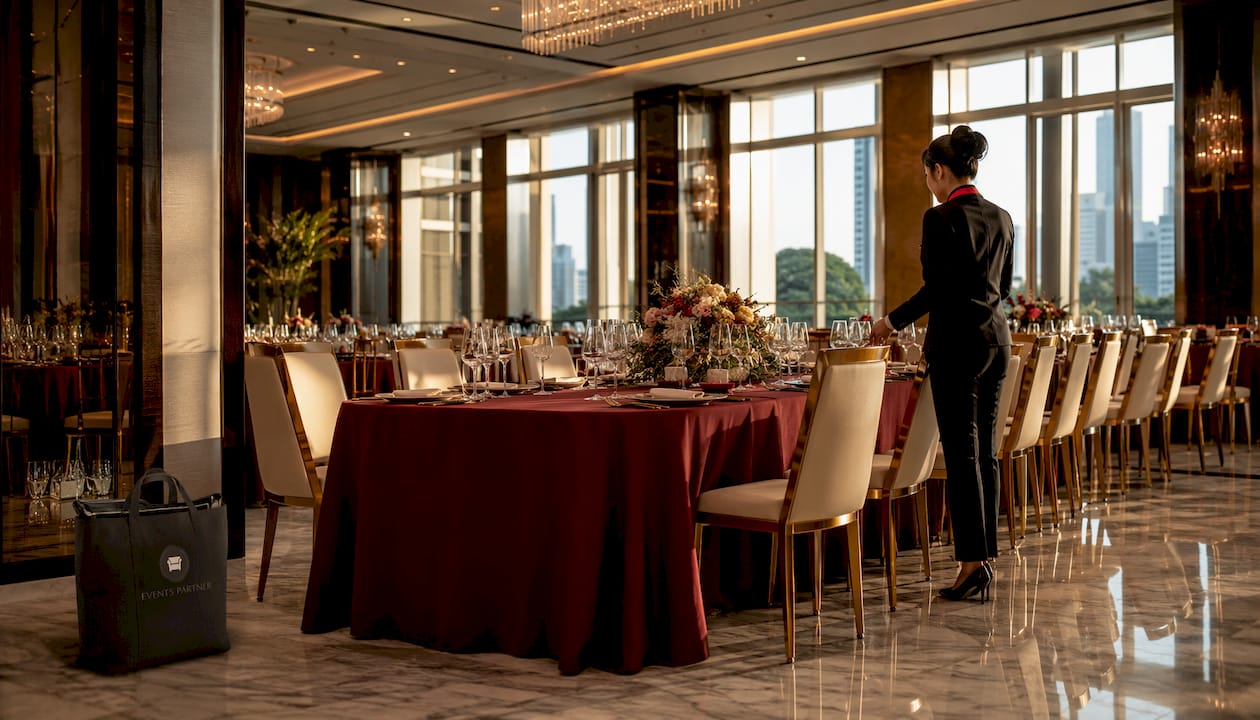
Private clubs hire furniture for events because it gives them immediate flexibility, tailored styling, and lower short-term cost than purchasing and storing seasonal pieces. Rather than committing capital to items used a handful of times a year, clubs pay only for what they need, when they need it, with delivery and setup included.
The three practical reasons clubs choose hire:
When to brief a supplier: For most club events, contact a hire company 8–12 weeks before the date. Peak seasons book out faster.
The case for hiring furniture at private clubs goes well beyond convenience. It touches member experience, brand cohesion, and how efficiently a club’s operations team can run a full event calendar.
Flexibility to scale and reconfigure. A golf club might host a prize-giving for 80 members on a Tuesday, a corporate hospitality day for 200 guests on Saturday, and a private wedding the following weekend. Venue stock rarely covers all three formats. Hire lets the team configure each event properly, pulling in the right chairs, tables, and lounge pieces for each occasion without compromise.

Cost and cashflow advantages. Purchasing quality banquet furniture for 200 covers costs tens of thousands of pounds. Hire spreads that cost across individual events, preserving capital for club improvements, staffing, or member amenities. For events that happen a few times a year, hire almost always wins on a per-event cost basis.

No storage, no depreciation. Furniture stored between events deteriorates. Fabric fades, frames warp, and stacking chairs get scratched. The club bears the repair and replacement cost. With hire, the supplier maintains the inventory and delivers it in good condition every time.

Access to specialist and branded pieces. High-end hire suppliers act as creative partners, offering full-service delivery, setup, and breakdown alongside items clubs could not justify owning: LED-integrated bars, branded reception counters, VIP lounge sets, and staging rostra. For a club that wants a consistent, polished look without a capital budget for bespoke furniture, this is a genuine advantage.
Operational efficiency on event day. A full-service hire partner consolidates delivery, setup, and breakdown into a single vendor relationship. Fewer moving parts means clearer scheduling during tight access windows, less coordination for the events team, and a cleaner handover to venue operations.
Member experience. Furniture shapes how guests feel in a space. The right chairs at the right height, lounge clusters that encourage conversation, and clear sightlines to a stage all contribute to an event guests remember positively. Hire gives clubs the ability to get this right for each event type rather than defaulting to whatever happens to be in the storeroom.
Pro Tip: Once a club settles on a preferred look and a reliable supplier, standardise the package. A documented furniture brief for each recurring event type speeds up booking across the season and removes the guesswork from every new enquiry.
Different club events have very different furniture requirements. Here is a practical breakdown of the most common formats and what each typically needs.
Pricing models vary by supplier, but most UK hire companies use a combination of per-item day rates, delivery and setup fees, and damage waivers. Understanding each component helps clubs build accurate budgets and avoid surprises on the invoice.
Common pricing components:
Sample illustrative budget breakdown (figures are indicative ranges only):
| Cost component | Illustrative range | Notes |
|---|---|---|
| Item hire (chairs, tables, lounge) | — | Varies by quantity and item type |
| Delivery and collection | — | Distance, access, and vehicle size |
| Setup and breakdown labour | — | Confirm whether included in hire rate |
| Damage waiver | 5–10% of hire value | Check what is and is not covered |
All figures are illustrative. Request an itemised quote from your supplier for accurate pricing.
Lead times by event scale:
Logistics checklist for club venues:
Modern booking practice treats furniture selection as a design process. Providing a clear brief, floor plan measurements, and a moodboard to your supplier early reduces install-day surprises significantly.
Hire is not always the right answer. There are situations where buying makes better financial sense, and clubs should know where that line sits.
Common drawbacks of hiring:
When buying makes sense:
Pro Tip: A hybrid strategy works well for most active clubs. Own your core inventory — the everyday dining chairs, standard banquet tables, and basic linen — and hire the signature pieces (VIP lounge sets, LED bars, staging rostra) that appear only for special occasions. This keeps storage manageable and keeps the event look fresh.
A thorough supplier brief protects the club and removes ambiguity on event day. Use this checklist when evaluating any hire company.
Contract and commercial basics:
Operational and logistics checks:
Compliance and safety checks:
Insurance and liability:
Quality and consistency:
Safety compliance is not optional, and the documentary burden sits with the club as the event organiser, not just the supplier. Here is what to request and verify before any event.
Fire safety for soft furnishings. All upholstered furniture used at UK events must comply with the Furniture and Furnishings (Fire Safety) Regulations. Ask every hire supplier for written evidence that their soft furnishings meet the required ignition resistance standards. This applies to chairs, sofas, cushions, and any padded lounge pieces.
PAT testing for powered items. If hired furniture includes integrated lighting, motorised components, or any electrically powered element, request a current Portable Appliance Testing certificate. This is standard practice and a reputable supplier will have it readily available.
Staging and floor loading. For events with raised staging or heavy furniture clusters, confirm the floor-loading specification with venue operations and cross-reference against the supplier’s stated weight limits. Clubs in older buildings should be particularly careful here.
Means of escape. Furniture layout must not obstruct fire exits or reduce corridor widths below the venue’s licensed minimums. Walk the floor plan with venue operations before finalising the layout.
Venue insurance coordination. Confirm that the hire supplier’s public liability insurance is compatible with the venue’s own policy requirements. Some venues require suppliers to be named on the venue’s event insurance or to provide a certificate of their own cover before load-in.
Pro Tip: Document every compliance check in the supplier contract and during the site walkthrough. A short email confirming fire certificates received, PAT test dates, and floor-loading sign-off creates a clear audit trail if anything is queried later.
Private clubs hire furniture for events because it gives them flexibility, specialist access, and lower short-term cost than purchasing, with delivery and setup included in a single vendor relationship.
| Point | Details |
|---|---|
| Book early | Book 4–6 weeks in advance for smaller events, 8–10 weeks ahead for mid-size galas, and 2–4 months ahead for large or multi-day events during peak season. |
| Hire beats buying for occasional use | Items used infrequently are usually cheaper to hire once storage and maintenance are factored in. |
| Request itemised quotes | Confirm hire rates, delivery, setup, damage waiver, and VAT as separate line items before signing. |
| Compliance is the club’s responsibility | Request fire-retardant certificates, PAT test records, and staging load specs from every supplier. |
| Events Partner | Provides full-service event furniture hire with delivery, setup, and breakdown for private clubs and corporate events. |
The clubs that get the most out of furniture hire are the ones that treat it as a repeatable programme rather than a one-off transaction. Once you have found a supplier whose inventory photographs match what actually arrives on the day, whose crew works efficiently in your venue’s access constraints, and whose account manager understands your event calendar, the process becomes genuinely low-effort. The first event is always the hardest.
What catches clubs out most often is not the cost or the logistics. It is the gap between what was agreed in an email and what the crew understood on the morning of load-in. A site walkthrough, a confirmed floor plan, and a single named contact on the supplier side close that gap almost entirely. Insist on all three.
The hybrid ownership model is also underused. Clubs that own their everyday dining chairs and standard banquet tables, then hire the VIP lounge sets and branded bars for special occasions, get the best of both approaches: predictable baseline costs and a fresh, event-specific look for the moments that matter most to members.
These resources informed the practical guidance in this article and are worth bookmarking for deeper reading.
For clubs that want reliable furniture hire without the back-and-forth of managing multiple vendors, Events Partner offers a practical alternative. The service covers the full scope of event furniture rental, from banquet rounds and dining chairs to VIP lounge sets, bar units, and staging, with delivery, setup, and collection handled by a single team.

Events Partner works with corporate clients, private clubs, hotels, and event agencies across a range of formats: members’ dinners, gala nights, conference setups, weddings, and corporate hospitality days. Pricing is transparent, inventory is real (not catalogue-only), and the logistics are managed so the club’s events team can focus on running the event rather than coordinating deliveries.
If you are planning a club event and want an itemised quote with confirmed lead times, get in touch with Events Partner directly through the event furniture rental page.
Renting furniture means hiring items for a set period, typically a single event or a day rate, with the pieces returned to the supplier after use. Most hire agreements include delivery, setup, and collection as part of the service.
Hire gives clubs flexibility to match furniture to each event type, avoids storage and maintenance costs, and provides access to specialist pieces (VIP lounge sets, staging, branded bars) without capital expenditure. Delivery and setup are usually included.
Recurring hire costs can exceed purchase price if the same items are needed very frequently. Availability can be limited at peak times, and managing hire agreements adds administrative overhead for busy events teams.
Hire is usually more cost-effective for items used fewer than 30–40 times a year, once storage and maintenance are factored in. Clubs with a high-frequency event calendar may find it worth owning core stock and hiring specialist or signature pieces as needed.
For smaller events, 4–6 weeks is usually sufficient outside peak season. For mid-size galas or corporate days, 8–10 weeks is safer. Large or multi-day events benefit from booking 2–4 months ahead to secure preferred inventory.



 Delivery Fees
 Payment Methods
 FAQ