

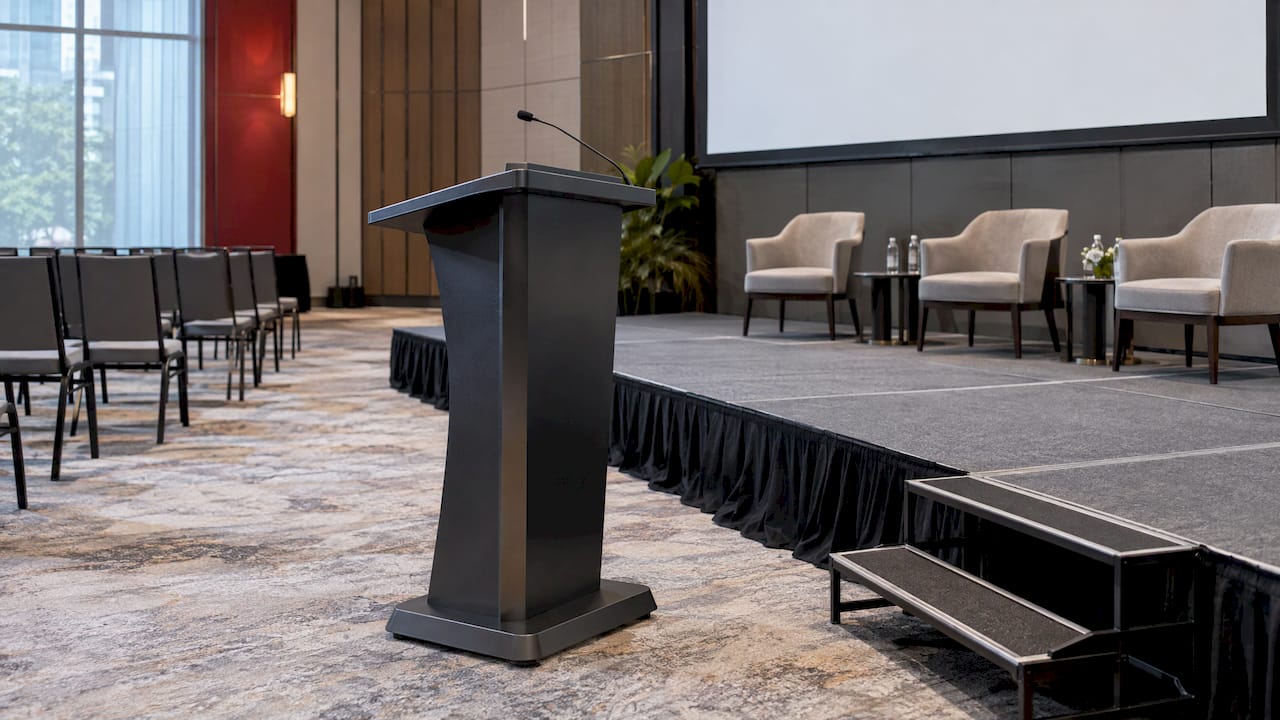
For most Singapore events, a freestanding speaker’s rostrum should stand roughly 1.0 to 1.2 m tall, with the top surface near the speaker’s elbow height. A base of about 50 x 50 cm suits a single presenter. That range covers most corporate talks, award nights and product launches. The right figure for your event still depends on who speaks, where, and from what kind of stage. This guide shows how to read the numbers, match them to your speakers and venue, and avoid setup problems on the day.
The word has two meanings, and mixing them up is the most common reason a rostrum arrives that does not suit the stage plan.
In dictionaries, a rostrum is any raised platform for public speaking. In Singapore event hire, planners more often use it for the speaker’s stand: a standing unit with a sloped or flat top where a presenter rests notes, a laptop or a microphone. Some people call this a lectern or a podium. Strictly, a lectern is the stand you read from, and a podium is the platform you stand on. If you want the full distinction, our guide to lectern versus podium for event planners sets it out.
This matters for height. A stand-type rostrum has a height measured from floor to top surface. A platform-type rostrum has a height measured from floor to its walking surface, usually only a few tens of centimetres. When you ask a supplier for “rostrum height”, say which one you mean.
There is no single legal or industry standard for event rostrum size. Products vary by design, but the ranges below are a reasonable planning starting point.
| Dimension | Typical planning range | What it affects |
|---|---|---|
| Overall height (stand-type) | About 1.0 to 1.2 m | Whether the top sits at a comfortable reading and elbow height |
| Top surface width and depth | About 50 cm wide, 25 to 50 cm deep | Space for notes, a laptop, a gooseneck microphone and a water glass |
| Base footprint | About 50 x 50 cm for a slim stand | Stability, and how much stage floor it uses |
| Weight | Varies by material | How easily it can be moved during changeovers |
| Finish | Black, white, stainless steel or wood tones | How it sits with your stage design and branding |
An ergonomics study of school rostrums in Kulim, Malaysia (Jaafar and Mohamad, 2023) used a height range of about 80 to 117 cm for a standing speaker’s work surface, based on elbow-height guidance for standing work. It also used a work surface of 50 to 100 cm long and 25 to 50 cm wide. Those figures are a useful cross-check: a rostrum much shorter than 80 cm forces a speaker to stoop, and one far above 117 cm blocks the face from the audience and strains the shoulders.
Suppliers often write dimensions in different orders. A line such as “50 x 50 cm x 1.15 m (H)” means a 50 cm by 50 cm footprint and 1.15 m height. If the spec shows a larger first number, such as 11.5, check whether it is the thickness of the top panel or the base plate. Ask which, because it changes how the unit sits next to a stage edge or a screen.
The best rostrum height depends on the people at it. A simple method works well for most events.
When speakers vary widely, a lower rostrum placed beside a small step or platform often works better than one tall unit. If you also have accessibility needs, plan a step-free route to the speaking position before choosing any platform.
The audience cares about a different height: how much of the speaker they can see. A rostrum that is too tall hides the speaker’s chest and face from the front rows behind a large arrangement of flowers or branding. A slim, open-fronted design keeps the speaker in view. If your logo goes on the front panel, plan its size around the rostrum’s front face, not the other way round.
Our VIP rostrum guide lists three checks Singapore planners make before booking, and it is a good companion when the speaker is a minister, chairman or guest of honour.
Many events pair a speaker’s rostrum with a low stage. Indoors, stages are normally kept low, because ceiling clearance, lighting and sightlines limit how high a platform can go. Taller stages suit large standing crowds outdoors, where people at the back need to see over heads.
Stage size is driven by what happens on it. A widely used rule of thumb in Singapore staging guides is a stage of about 2.4 m x 2.4 m for speeches, an emcee or a prize presentation, and about 4.8 m x 3.6 m for a small band, dance item or lucky draw. Anything with a full band or lion dance needs 7.2 m x 4.8 m or more. Those figures give a speaker’s rostrum, an emcee and a couple of award presenters enough room without crowding.

To size the floor in front of the stage, count the people at the busiest moment. Allow about 1 m² per person standing still, and about 2 m² per person who is moving. Then add floor space for equipment such as a lectern, and check the ceiling height before you commit to a raised stage indoors.
For creative ideas on how stage shapes and levels can shape sightlines in production, see these creative stage design ideas. For furniture placement on panel and award stages, our panel stage layout guide and award ceremony stage furniture guide go step by step.
Say you run a product launch in a hotel ballroom with a 3 m x 2.4 m low stage. You have one emcee, two executives and a guest of honour. The tallest executive is 1.85 m and the emcee is 1.60 m.
The result is a stage where each person has a place to speak, nothing blocks the screen, and the rostrum height has been tested against actual people.
Height is only one measure. Three more shape how a rostrum fits your event.
Footprint. A 50 x 50 cm base is common for a solo presenter. Larger tops suit presenters with a laptop and printed notes. If your stage is shallow, a slim base saves floor space for a second speaker or a signing table.
Finish. Black suits a dark stage or a clean corporate look. White suits weddings, solemnisations and bright product launches. Stainless steel looks formal under stage lights and in award settings. Pick the finish that matches the furniture around it, for example the chairs and sofas on a panel stage.
Branding. If you want a logo or message on the front, ask about custom sticker branding at the time of enquiry, so the artwork matches the front panel size.
Rostrum hire is priced per unit for the event, and the item price is only part of the total. We do not publish a rostrum price list, so request a quotation for your dates and quantities through our site. Venues that include a rostrum with a gooseneck microphone in their own packages often list it as a separate line item, which shows how it is commonly treated as a distinct, priced item.
What changes the total is mostly logistics. Our published delivery, setup and teardown fees, charged as a one-off per truck per trip, are:
| Timing | Standard truck (14 ft), orders up to S$999.99 | Standard truck (14 ft), orders S$1,000 and above | Heavy truck (24 ft), orders S$1,000 and above |
|---|---|---|---|
| Office hours | S$60 | From S$65 | From S$130 |
| After office hours | S$120 | From S$130 | From S$260 |
| Night shift hours | S$180 | From S$195 | From S$390 |
A stairs surcharge of 50% and a same venue turnover fee from 20% may also apply. Full terms are on our delivery and setup fees page.
The practical lesson: a rostrum is a small item, so it usually travels with a larger order. Bundling the rostrum, chairs, tables and lounge pieces into one delivery spreads the trip cost across the whole setup and avoids a second truck.

Most rostrum problems are not about the rostrum. They are about assumptions that nobody wrote down. Before you confirm, check these points.
If your event has an exhibition or booth element, our exhibition booth seating layout guide covers aisle clearances, which matter as much as height when a venue inspects your setup.
We supply event furniture for corporate events, conferences, award ceremonies, weddings and launches in Singapore, with delivery, setup and collection included in our service. Our rostrum range includes the Clarion rostrum in black, the Clarion rostrum in white and a stainless steel rostrum. Open the product pages to compare finishes, then request a quotation through our digital platform.

If the rostrum sits inside a bigger setup, our conference furniture rental page shows how chairs, tables and stage pieces fit together. For award nights, see our award ceremony furniture category. Our space planning and styling service can help when you want a layout checked before delivery.
There is no single standard, but stand-type event rostrums commonly measure around 1.0 to 1.2 m overall. A 1.15 m unit is a typical example. Choose by your speakers’ elbow height rather than a headline number.
A slim speaker’s rostrum often has a base of about 50 x 50 cm and a top surface of 25 to 50 cm deep and up to about 50 cm wide. Always confirm both the floor-to-top height and the top size in centimetres before booking.
The price depends on the model, the number of days and what else you hire. Delivery, setup and teardown are charged separately, based on truck size, timing and access. Request a quotation with your dates and venue so the item and logistics costs appear together.
Not strictly. A lectern is what a speaker reads from, a podium is a small platform a speaker stands on, and a rostrum is a general term for a speaking platform or stand. In Singapore event hire, “rostrum” most often means the standing speaker’s unit.
Most event rostrums are fixed height. Where speakers differ a lot, plan around the tallest presenter and use the microphone position or a small step to help shorter speakers. Raise this with us when you request your quotation.
#EventFurnitureSingapore #RostrumRental #ConferenceSetup #EventPlanningSG #StageLayout



 Delivery Fees
 Payment Methods
 FAQ