

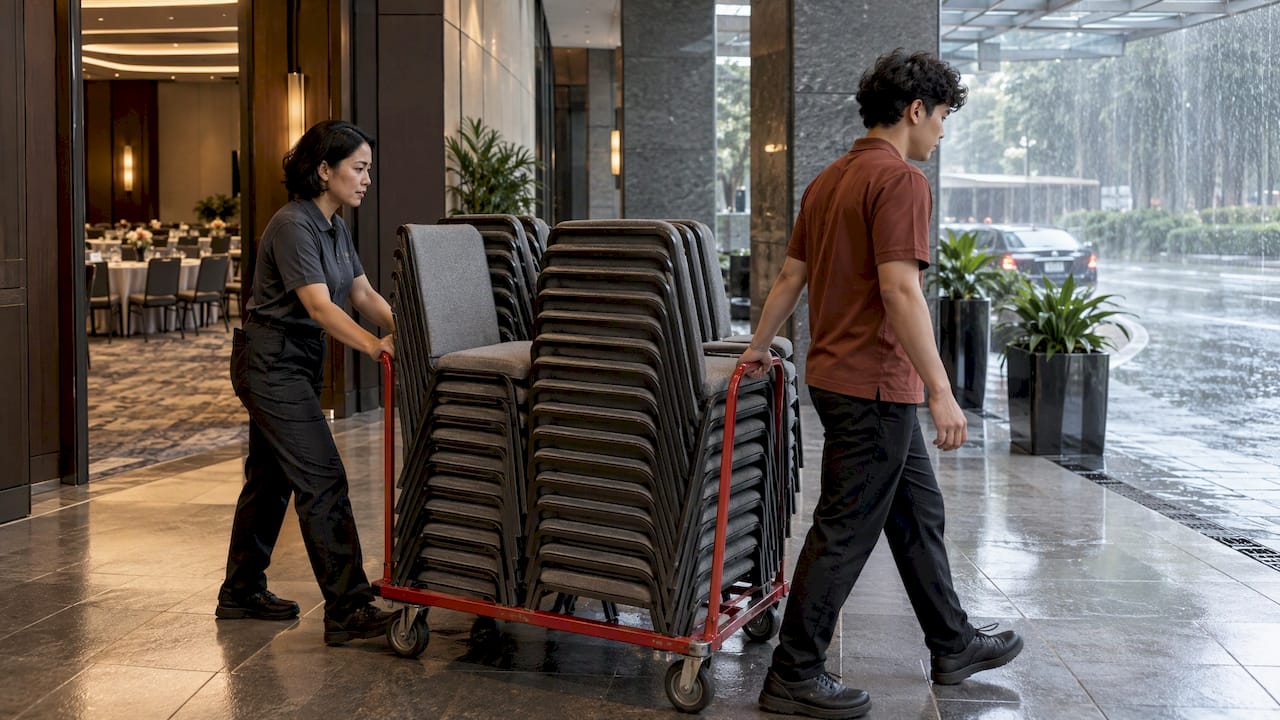
A good wet weather plan for a Singapore event is decided at booking, not at the first rumble of thunder. It names a sheltered fallback space, one person with the authority to make the call, a written trigger and a decision time. It also settles the part most plans skip: the furniture. Chairs, tables, lounge sets and counters have to be delivered, set up and, if the weather turns, set up again somewhere else. If your furniture brief covers both layouts from the start, a wet day becomes a scheduled switch and not a scramble.
This guide is for organisers, planners, venue teams and brand managers running outdoor or semi-outdoor events in Singapore, from rooftop receptions and atrium activations to roadshows and garden weddings.
Most rain plans are written around people: where guests go, who tells them, when. That is necessary, but a plan that only moves people leaves a ballroom with no seating, a covered walkway with no cocktail tables, or a hall that holds 150 standing guests when 220 are arriving.
Furniture is physical, bulky and tied to a delivery slot. Unlike a speaker or a banner, it cannot be carried across a venue by one crew member. Chairs for a 200-guest dinner mean pallets, trolleys, lifts and a loading bay. When the fallback is another room, another floor or a covered section of the same venue, you are asking the same question twice: what goes where, how it gets there, and who does it before guests arrive.
That is why the rain plan belongs in your furniture brief. If your supplier knows from the first quotation that there are two possible layouts, the delivery schedule, truck size and crew timing can be planned around both. If the supplier hears about Plan B at 2 pm on event day, you are negotiating a rush job at after-hours rates.
Our event furniture checklist for organisers and planners is a useful companion here, since it lists what to confirm before a booking is locked.
Four decisions belong in writing before the event is confirmed. Settle them with the venue, your client and your suppliers together.
Name the space: an indoor ballroom, a covered carpark level, a function room, a sheltered section of the same venue. Then time the move honestly. Walk it with the venue contact and count the minutes for guests, and separately for furniture, décor and equipment. A fallback that is “available” but needs 90 minutes to convert is not a fallback for a 6 pm start unless the decision is taken early enough.
If the plan is tentage or a canopy, confirm with the venue whether temporary shelters are allowed and whether they need prior approval. Approval can take time, so it should be requested when you book, not when the forecast turns.
Be careful about relying on tents alone in severe weather. A tent keeps rain off but does not make a thunderstorm safe, so the written plan should still include a move to a proper building when lightning is reported nearby.
A plan needs one person with the authority to make the call. Committees do not work when guests are already standing under a canopy asking what happens next. Usually this is the event producer or lead organiser, with one named client decision maker for anything that means changing venue or cancelling. Also agree that any team member may stop an activity if someone is at risk, without waiting for sign-off.
“Can we move indoors if it rains?” is too vague to act on. A trigger is a condition you can check: an MSS lightning alert for the venue area, a heavy rain warning, or rainfall that persists past an agreed time. An action is attached to each trigger: move guests indoors, switch to battery-powered audio, delay the start by 30 minutes. Write the triggers into your run-sheet and, for weddings and private functions, into the agreement with the venue.
Confirm vendor thresholds too. Audio-visual and lighting crews often have their own rules for pausing a show when lightning is reported, and these can differ from supplier to supplier and venue to venue. Collect each one and write it down so nobody discovers a mismatch mid-event.
Set a time after which the layout is fixed and the supplier is told which one to build. Many Singapore organisers use a point about 24 hours before the event for the main decision, with a final on-site check closer to guest arrival. Which time is right depends on how long your furniture switch takes. The longer the conversion, the earlier the decision must be.
Singapore weather changes quickly, and lightning is the signal that matters most for safety. MSS operates a lightning alert service through the myENV app and weather.gov.sg. The service shows cloud-to-ground and cloud-to-cloud strokes from the last 30 minutes, refreshed every 5 minutes. MSS issues an alert when cloud-to-ground lightning is detected, or thundery showers are forecast, within a 6 km radius for the next two hours. It then follows up when no lightning has been observed for 30 minutes.
Two practical points follow.
A useful setup is a short list: the venue location, the phone of the named decision owner, the phone of the venue contact and the action attached to each alert. Turning on every notification is not a plan. One person should receive the alert, know the rule and act on it.
For flood-prone routes, such as access roads and loading bays with low points, watch heavy rain and drain-level information together. A truck that cannot reach the loading bay is a rain problem even when your event space stays dry.
This timeline works for most outdoor corporate events, launches and receptions. Adjust the hours to the length of your furniture switch.
| When | Action | Owner |
|---|---|---|
| At booking | Fix fallback space, triggers, decision time and named owner. Brief supplier on two layouts. | Organiser |
| 1 week before | Start checking the NEA forecast. Confirm Plan B access, lift booking and loading bay slot with the venue. | Organiser, venue |
| 48 hours | Check forecast again. If significant rain is possible, alert the fallback venue and your furniture supplier. Draft the guest message. | Organiser |
| 24 hours | “Soft call”: tell guests and vendors a switch is possible. Main layout decision for events with long conversion times. | Decision owner |
| 4 hours | “Hard call” on setup location if delivery has not yet happened. | Decision owner |
| 2 hours | Final on-site assessment with the MSS alert status and the safety lead. | Safety lead |
| During event | Pause on lightning alert, move guests per the written action. Resume only after the all-clear conditions are met. | Decision owner |
The exact hours are a working convention, not a rule. What matters is that each point has a person attached and a message ready. Drafting the “rain trigger” messages two days ahead means a single broadcast can go out in seconds, through a dedicated WhatsApp or Telegram group for guests, crew and vendors.
This is the step that turns a plan on paper into a plan that works.
Indoor fallbacks are usually smaller than the outdoor space. A reception for 150 that spreads across a terrace may need to be tighter indoors, so decide early what gives: fewer lounge clusters, more cocktail tables, standing instead of seated, or a two-wave schedule. Keep clear aisles in both versions. Our guides on standing reception layouts with 1.5 m aisles, conference seating layouts and networking zone layouts give you dimensions to draw both options against. For booths and exhibition halls, see the exhibition booth seating layout guide, which covers 3.0 m aisles.
A simple method works well:
For events with a real chance of a switch, lighter and stackable pieces such as chairs, cocktail and bar tables and barstools are quicker to reposition than heavy sofa groupings. If a lounge area is central to the experience, decide in advance whether it moves as a unit and where it lands indoors, so the layout does not have to be redesigned under pressure.
Wet shoes, trolley wheels and rain-dampened loading routes put pressure on indoor floors, and venues are strict about this. Plan the route from loading bay to hall and agree floor protection with the venue early. Our guide to event floor protection covers the options for Singapore planners. If anything is marked or damaged in a hurried switch, the event rental damage policy explains what organisers should know before they sign.
A changed layout is still a layout. Venues, and in some cases the fire safety authority, expect clear exits and aisles in whichever version you use. Run Plan B through the same checks as Plan A. Our event furniture compliance checklist walks through what to confirm so a last-minute layout is not rejected on the day.
Plan B has a cost, and it is far easier to approve at booking than to explain afterwards. Our published delivery, setup and teardown fees depend on the time of day, truck size and order value. They are one-off charges per truck per trip.
| Time window | Standard truck (14 ft), orders up to S$999.99 | Standard truck (14 ft), orders S$1,000 and above | Heavy truck (24 ft), orders S$1,000 and above |
|---|---|---|---|
| Office hours | S$60 | from S$65 | from S$130 |
| After office hours | S$120 | from S$130 | from S$260 |
| Night shift hours | S$180 | from S$195 | from S$390 |
Two surcharges matter most when you are planning for rain. A stairs surcharge of 50% applies where access is by stairs, which is a real factor if your fallback is on another level without a goods lift. A same venue turnover fee, from 20%, is listed for a change of setup within the same venue. The full schedule is on our delivery and setup fees page.
The planning lesson is about timing. A switch decided during office hours sits in a different fee band from one forced into the evening or the night shift. The earlier you fix the decision time, the more likely the conversion falls inside the cheaper window. When you ask for a quotation, state that a second layout is possible so the schedule and fee bands can be built in from the start.

The written action should be short enough to remember:
Check your event insurance for weather-related cover before the event, not after. Ask the policy provider what is covered and under what conditions. Keep electrical equipment, cabling and AV on raised, covered positions, and agree with your AV crew what they will do on a lightning alert.
Resume only when your written conditions are met. MSS follows up when no lightning has been observed for 30 minutes, and many organisers use that as the earliest point at which to consider resuming, with the safety lead confirming on site.
Guests handle a change well when they expect it. Add a line to the invitation or confirmation email that the event may move indoors in case of weather, and where to look for updates. For weddings and solemnisations, a short note in the invitation does a lot to soften an announcement on the day.
On the day:
Keep an emergency kit by the entrance: umbrellas for roughly a third of your headcount, non-slip mats and towels.
Corporate receptions and rooftop events. Rooftops are exposed and often reached by lifts with limited capacity, so Plan B logistics matter as much as shelter. Our rooftop event venues guide covers how to choose and set up.
Weddings and solemnisations. Write activation triggers into the venue agreement, prepare separate sunny-day and rainy-day run-sheets and add a 15 to 20 minute buffer to the rainy-day version for movement and seating.
Conferences and exhibitions. Mostly indoors, but arrival zones, registration queues and loading routes are exposed. Plan covered queuing and protected unloading so that wet weather does not delay doors opening.
Roadshows and atrium activations. Portable furniture must be quick to relocate. Agree the covered alternative position with the mall or site manager at booking, and decide whether furniture stays outdoors at all during a warning.
Gala dinners with an outdoor cocktail hour. Plan for the cocktail hour to move indoors while dinner stays put. This is the easiest switch to build, because the indoor room already has its furniture and only the cocktail tables and bar counters need a new home.

We supply event furniture across Singapore, including chairs, meeting and dining tables, coffee and side tables, lounge pieces, bar tables and counters, with delivery, setup and collection included in our rental service. We also offer space planning and styling, which is useful when you need two layouts drawn and counted before the quotation.
If you tell us at the start that your event has a wet weather alternative, we can quote against both layouts and show the delivery fees for each time window. Browse the range or request a quotation through Events Partner, and read what to prepare before booking so your first brief is complete.

The sooner the second layout is on paper, the more options you keep on timing, access and cost. If you are comparing suppliers, our guide on choosing a reliable event furniture rental partner sets out the questions worth asking.
Decide the rule at booking and the time at the planning stage. Many organisers use about 24 hours before the event for the main layout decision, followed by a final check a few hours before guests arrive. The longer your furniture switch takes, the earlier the decision must be.
A sheltered fallback space with its move time, a named decision owner, written triggers and actions, a decision time and a guest communication plan. Add venue approval for any tents, protection for décor and non-electrical supplies, and agreed vendor thresholds for pausing on lightning.
Yes. MSS says most lightning strokes occur within 5 to 6 km of a storm cloud, and strokes from storms more than 10 km away can still strike a location. Pause outdoor activity on an alert and move people to a proper building. Absence of an alert does not mean it is safe if conditions look threatening on site.
Prepare the message in advance and send it through a single broadcast group such as WhatsApp or Telegram. Add a line in the invitation that the event may move, and place signage at the outdoor site pointing to the fallback. Brief front-of-house staff so they give guests the same instructions.
It can. Our delivery and setup fees vary by time window, truck size and order value, with a 50% stairs surcharge and a same venue turnover fee from 20%. Deciding early keeps the work in a lower fee band, so tell us about your Plan B when you request a quotation.
#EventPlanningSingapore #WetWeatherPlan #EventFurnitureRental #OutdoorEvents #SingaporeEvents



 Delivery Fees
 Payment Methods
 FAQ